Buying Guide: Best DACs, Headphone Amps and DAC/Amp Combos to buy in 2026
As we head into 2026, join us at The Audio Files as we round up some of the best and most compelling products in audio source gear. No matter if you're looking to spend a few hundred, or thousands for the best you can get, we've got you covered!

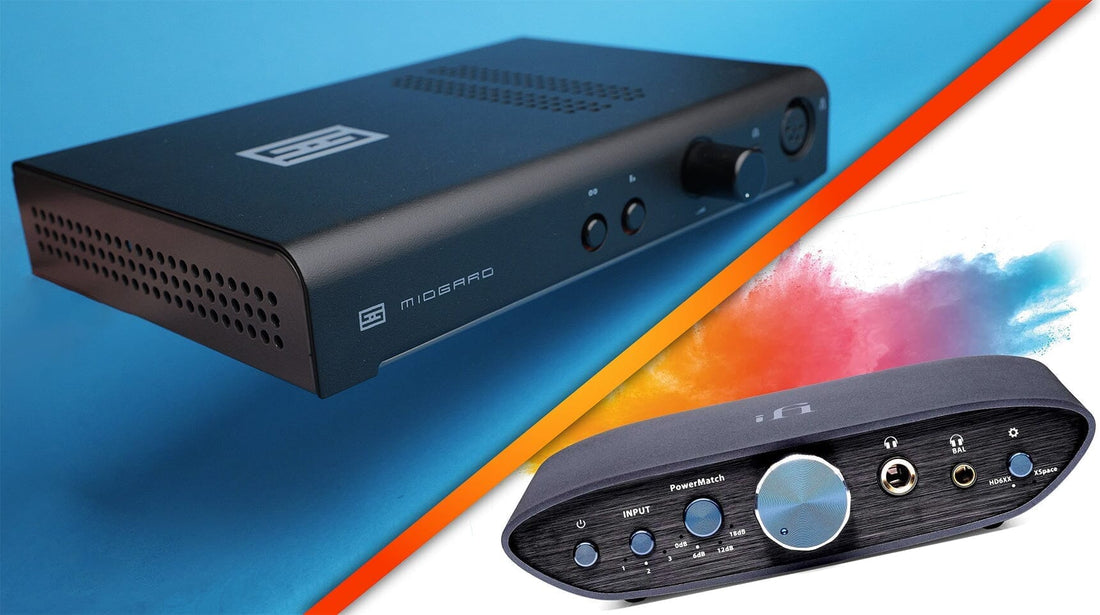
2025 saw the release of many new source gear products, as well as some refreshes and updates to existing options that together have shaken up my recommendations a fair bit, although some strong contenders are reclaiming their spots this year. With incredible performance available at temptingly low prices, there has never been a better time to be in the market for a new DAC or amplifier for your setup. So, as we head into 2026, I’ll be going through my picks for DACs, Amps, and Combo units at four different price ranges and why if you’re looking for a new piece of source gear, you should be looking at them too!
DACs
Entry Level (<$300) - CrinEar Protocol Max


CrinEar Protocol Max
Crinacle might not be a name that springs to mind when you think of source gear, being well known for his reviews and work in the IEM market, but with his own brand CrinEar’s first foray into the electronics side, they have most certainly started off strong. The protocol max is a USB-C dongle DAC & amp combo, offering half a watt at 32 Ohm, plenty to drive the vast majority of headphones besides perhaps much more demanding planars, whilst also keeping a high enough dynamic range that it fares excellently with sensitive IEMs where noise floor can frequently be a challenge.
I reviewed the Protocol Max recently, which you can watch below, and was quite impressed!:
Safe to say, subjectively and objectively this product is powerful, performs excellently, and when you add to that features such as a built in parametric EQ configurable via the Hangout.audio graph tool, it becomes hard to recommend almost anything else. Regardless of whether you’re looking for an upgrade to your PC’s motherboard audio or a high performance but budget friendly option to take on the go, the CrinEar Protocol Max is an excellent choice.
This is technically a DAC and amp combo, which may have you wondering what it’s doing in the standalone DAC section. The simple answer here is that there is no real reason why a DAC/Amp combo cannot be used as a standalone DAC so long as it performs well, which the Protocol Max most definitely does.
The outputs when set to max volume output a line level 4V balanced and 2V single-ended, eliminating any concern about ‘over-driving’ amplifier inputs. Even if you have no intention of ever connecting a headphone directly to your unit, the Protocol Max performs excellently as a standalone DAC to feed into other dedicated amplifiers, and within this budget, there are few truly meaningful upgrades amongst the competition.
Mid-Tier ($300-$1000) - Eversolo DMP-A6

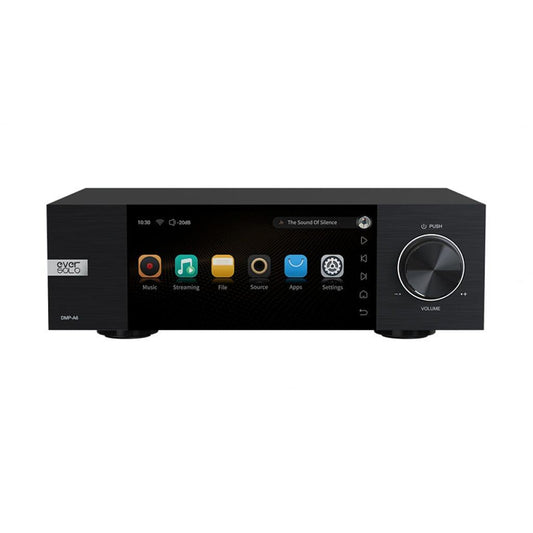
Eversolo DMP-A6 Streamer and DAC Gen 2
The Eversolo DMP-A6 took the mid-tier recommendation slot last year, and re-affirms its place for 2025. The DMP-A6 is a DAC and network streamer, offering a far more impressive user experience and features than even streamers or DACs costing orders of magnitude more.
Unlike typical DACs that must be connected directly to the source via USB, SPDIF, AES or I2S, the DMP-A6 can operate as a wired or wireless network streamer, playing music directly from various sources including Roon, Spotify connect, Tidal connect, Airplay and more. Don’t happen to have a phone or control device handy? No problem! It can also run these services directly thanks to its custom android based OS and the large, crisp display. Or of course you can indeed hook it up directly via standard USB or SPDIF inputs as you would any other DAC.
Since reviewing the DMP-A6, I’ve often kept the unit in my setup simply for the absolutely stunning display alone. When playing via Roon or local files, the album art and playback progress of your current track is displayed, with an optional and customizable visualiser in the background to boot.
Both objectively and subjectively the DMP-A6 offers impressive results. However it would be fair to say that there is a very very slight performance advantage to some competitors such as the SMSL RAW Pro DAC, or Eversolo’s own DAC-Z8.
The reason the DMP-A6 still wins out for this slot is that in my opinion, a ~5% difference in performance is far less of a benefit than the wealth of features offered by the DMP-A6, and how enjoyable this device is to use. The EQ feature alone can unlock far greater sound quality benefits than any DAC upgrade possibly could.
For those that are happy for a still truly excellent sound and find the tradeoff of perhaps a few percent difference in absolute quality for the benefit of inbuilt streaming, a gorgeous album art display, and of course; built-in EQ! Then the Eversolo DMP-A6 will be right at home on your desk.
High-End ($1000-3000) - Ferrum WANDLA

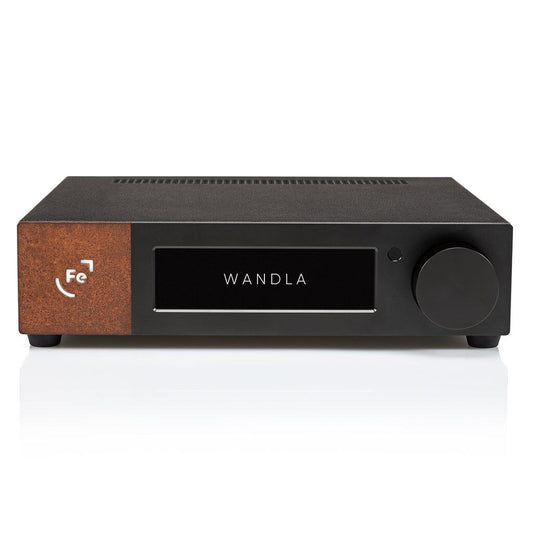
Ferrum WANDLA 2.0 DAC
Before I get into this section, it’s important for transparency to note that I do have a collaboration edition of the WANDLA available, so please feel free to read this section with the level of skepticism you deem appropriate.
The WANDLA has been the primary DAC in my headphone system for the last two years, and at the moment I’ve not heard anything that has tempted me away from it. DACs as you go towards the higher end of the market can get…..rather large. My personal favourite DAC at any price; the Holo May KTE for instance is hardly desk friendly, coming in at 30cm deep and nearly half a meter wide, on top of the 18kg/40lb weight!
The WANDLA is quite a contrast, with a compact form factor easy to integrate into almost any setup even if stacked with the optional HYPSOS power supply upgrade. But do not let its size fool you, inside this unit is the best sounding implementation of ESS’ flagship DAC chip I have heard to date, matched only by the Weiss 501 and Ideon Absolute Meta DAC, both of which are getting comfortably into car-money territory.
There are plenty of other products utilising flagship ESS DAC chips, but Ferrum’s design has some secret sauce design features which put it in a higher tier of both objective performance, and resulting sound quality versus many other options.
The first is in regards to their current-to-voltage conversion stage. Ferrum did not just design an I/V stage that measured well, or picked the design that measured the best, they instead iterated through designs until they had several which all measured excellently, and then selected the final design and made final tweaks based on listening tests and subjective decision. The result is a DAC that has truly impressive technical capability, with a more natural and realistic presentation than any other ESS DAC I have heard thus far.
Additionally, Ferrum designed the ‘SERCE’ compute module, which provides quite substantial processing power and allowed them to collaborate with the man behind the HQPlayer upsampling tool to implement a PCM oversampling filter that outperforms almost all DACs on the market besides those from Chord Electronics.
If you do opt for the GoldenSound edition either at purchase or a later upgrade, this does push us slightly above the $3000 limit, but you’ll likely find this worth the extra cost thanks to the three additional features you get in return:
“Impact+”, which enables a customised EQ to bass content in your music, to improve not just bass quantity, but the actual sense of impact and ‘punch’, all computed with 64 bit precision. “Tube Mode”, which changes the way in which the DAC itself operates to cause it to intentionally produce higher levels of harmonic distortion, but only 2nd order harmonic distortion (an upcoming firmware update expands this feature to offer simulation of the different distortion profiles of specific tubes such as 2A3, KT88, 300B or EL34), allowing you to at the touch of a button add some tube warmth and flavour to your sound.
And “Spatial Enhancement”, which is the killer feature of this device. This was only possible thanks to the compute power available in SERCE, and is a new approach to expanding the soundstage and spatial presentation of your music in a manner that produces a far more realistic result than traditional crossfeed.
The combination of the tough to beat inherent performance of the DAC itself, and the additional features such as high performance oversampling, spatial enhancement, and tube simulation on the GSE edition, have meant that this is the DAC I’ve continued to use as my reference point in my own headphone system.
Summit-Fi (>$3000) - Holo Audio May

Click here to visit the product page for the Holo May
The Holo May KTE also keeps its spot as my Summit-Fi recommendation for one simple reason:
I’ve yet to hear a DAC at any price I enjoyed more than this….
The Holo Audio May is a non-oversampling R2R DAC with a number of enticing aspects, and is to this day my favourite DAC of all that I’ve heard, beating many even at considerably higher price points.
It is objectively the best performing discrete R2R DAC, and not just by a small margin either. Whilst many competing R2R DACs hover around the -100dB THD+N mark, the May gets all the way down to -118dB and achieves a whopping -140dB of true dynamic range to boot! This is higher dynamic range than even many of the best delta-sigma DACs I have measured.
Not only does it impress objectively, but subjectively this DAC offers absolutely class leading resolution, and simply the best and most convincing vocal and instrument timbre I’ve heard in a digital product. BUT there are caveats to this product that mean this can indeed be what I feel is one of the highest performance DACs available, though only if you’re prepared to do some extra work to get there.
The May is a “NOS” or ‘non-oversampling’ DAC; it does none of the digital processing, oversampling or ‘reconstruction’ of the sampled digital data usually done by a DAC. For some, this is a huge benefit, with many listeners finding that NOS (which is only possible on R2R designs) brings a warmer, more pleasing sound that they simply cannot get with delta-sigma DACs as by design they cannot operate at the native 44.1khz sample rates of most music.
For myself and others, the sound of correctly reconstructed, oversampled audio is the better way to go. Unfortunately, the May’s optional built in oversampling is the weakest aspect of the product.
This is somewhat intentional, with the designer Jeff Zhu arguing that if you’re using a DAC of this tier, you should either be running it non-oversampling for the unique presentation that the lack of any digital manipulation whatsoever on a true native PCM converter can provide. Or that if you do prefer oversampling, you should be using the best possible oversampling, which is exactly why this DAC supports twice the input sample rate of the majority of other DACs on the market at a whopping 1.536Mhz. This allows you to use a tool such as Signalyst HQPlayer, PGGB, or the Chord MScaler to combine the most accurate PCM reconstruction with the most accurate discrete R2R DAC money can buy. When combined with a properly configured HQPlayer setup (click here for my HQPlayer settings), the May produces the best sound from a DAC out of everything I have tested to date, with objective performance that doesn’t just beat but leaves every other R2R DAC on the market besides holo’s own other products in the rear-view mirror.
For those that prefer to listen to content in DSD, either from native DSD sources or upsampling to DSD with the modulators in both HQPlayer and PGGB that outperform the internal modulators of commercial delta-sigma DACs, the May also has a separate discrete DSD converter that supports rates up to DSD1024.
If using external oversampling, even if just the built in features in Roon or Audirvana are a non-starter for you, then the May is likely not the best option unless you already know you prefer the sound of NOS. But if you are willing to turn on oversampling in your player, or better yet use HQPlayer, the May is still my favourite DAC and I’ve yet to hear another that has dethroned it.
Headphone Amps
Entry Level (<$300) - iFi Zen Can Signature & Schiit Midgard

Click here to visit the product page for the Schiit Midgard
Click here to visit the product page for the iFi Zen Can Signature
Last year the entry-level slot was taken by the Schiit Midgard, this year I was torn between awarding the slot to the Midgard once more or swapping to the iFi Zen Can Signature. In the end, I thought “why not both”?
Each of these are excellent devices for different reasons and tastes, and deserving of some discussion.
First, the Midgard; Schiit is a company that is uniquely transparent about not just their beliefs about how products ‘should’ be designed, even going so far as to actively explain why they dislike certain approaches such as entirely opamp based headphone amplifiers but still sell them themselves. (That ‘heresy’ name wasn’t just a funky sounding title!)
But they also are one of very few companies that offer fully discrete designs at exceedingly low prices, and the Midgard is exactly that. A 6W, fully discrete headphone amplifier, using a feedback approach that factors in distortion produced by the headphone driver itself in addition to the amplifier, to attempt to reduce distortion in ways a typical amplifier would not.
In our own measurements, we didn’t find that this particular aspect really did anything to that effect, but it was still otherwise an excellently performing device objectively, and one that I was extremely impressed with subjectively. Plain and simple: it sounds great and can drive just about anything.
The Midgard is not as bright as most of the nested-feedback designs often discussed at these pricepoints, sitting much closer to what I’d consider a “true neutral” sound. But for those wanting something that does lean slightly warmer, to add a little bit of coloration whilst still retaining excellent detail retrieval and technical capability, that’s where the Zen Can Signature comes in.
The Zen Can Signature is not quite as much of a powerhouse as the Midgard, offering just under 2W of power at 32 Ohm, however this is still in all likelihood more than you will ever need. (Click here to watch our ‘do I need an amp’ video to learn about how much power you actually require!).
For the sacrifice in power, you gain some features such as XBass, an analog EQ that lifts your subbass to give additional impact and rumble to music that demands it, a feature I’ve found extremely useful in particular with many dynamic driver headphones which tend to have a roll-off as you go down to the lowest frequencies. There are also headphone-specific variants of the Zen Can Signature available for the Sennheiser HD6XX, Hifiman (various models), and Meze 99 classic which provide headphone specific EQs at the touch of a button.
The biggest change is in the inherent sound, the Zen Can Signature is noticeably warmer than the Midgard, providing a more lush, intimate presentation that pairs better with brighter headphones such as the Hifiman HE600.
In terms of pure technical performance, the Midgard still wins out, but for overall enjoyment and the ‘best’ option in this price category, it will simply depend on your preferences. For more of a reference sound, the Midgard delivers that. And for a warmer, more ‘fun’ tuning with some additional features that will be especially eye catching for Hifiman, Sennheiser or Meze owners, the Zen Can Signature could be an equally great or perhaps even more enjoyable option.
Mid-Tier ($300-$1000) - Singxer SA-1 V2


Singxer SA1 V2 Headphone Amplifier
Click here to view the product page for the Singxer SA-1 V2
The Singxer SA-1 is an amplifier that holds a special place in my heart, enough so that as well as continuing to be the amplifier I recommend to many of the people that ask what they should be looking towards as an upgrade with a decent budget to commit, it also reclaims its spot on this list for 2025.
Similar to the Midgard, and unlike the majority of products under $1000, the SA-1 forgoes the use of IC opamps in favour of a fully discrete class AB design.
With 6W @ 32 Ohms, the SA-1 has no trouble powering almost any headphones on the market, but also achieves one of the highest SNR ratings at 50mV of 93dB, making it one of the most ideal choices for IEM users who require a whisper quiet noise floor.
For me what I loved about the SA-1 was the complete and utter lack of harshness or glare in its presentation. I tend to find that many opamp based amplifiers have a fatigue inducing sharpness to their sound. This is something which some amplifiers do avoid, but do so by being generally softer and less resolving. The SA-1 meanwhile retains a level of detail that goes toe to toe with options like the Topping A90 and even the considerably more expensive Ferrum OOR, but avoids leaning toward a more coloured, warm sound to attempt to hide any harshness in the resulting sound. It sits right in the middle and in my opinion is one of the most truly transparent sounding amplifiers available. One that I recommend to many because once you have this, there truly is no need, perhaps even no benefit to upgrading unless you’re willing to spend nearly an order of magnitude more on your device. This amplifier to me represents a surprisingly clear cliff beyond which diminishing returns become punishingly expensive.
Singxer hit it out of the park with this one, and under $1000, there’s no other amplifier that impressed me more.
High-End ($1000-3000) - Holo Bliss

Click here to visit the product page for the Holo Bliss
If the Singxer SA-1 had a big brother, this would be it. And by big, I do mean big….
Coming in at over 10kg and 43cm wide, this is one you’ll want to make sure you have space for before hitting purchase, especially since stacking other devices on top of it isn’t recommended due to the amount of heat this device kicks out. But what do you get for all that space and power consumption? You get a fully discrete, full class-A amplifier which can crank out 12W @ 32 Ohms, multiple sets of selectable XLR and RCA inputs, a selectable preamp output, a massively over-specced linear power supply, high and low output impedance options to tweak the frequency response of your headphones, and simply grin-inducing performance.
With THD+N of 118dB even when pumping out buckets of power, and a unique relay controlled volume adjustment that not only attenuates the signal as normal, but also adjusts the gain of the amplifier itself at several stages to maximise dynamic range at all levels. It allows the Bliss to achieve 91dB SNR at 50mV, making it an absolute powerhouse of an amplifier for the most demanding headphones, whilst outperforming the vast majority of the market in keeping a whisper quiet noise floor for IEMs.
The sound of this amplifier blew me away, especially with more demanding headphones like the Hifiman Susvara. Able to deliver seriously impressive levels of macrodynamic impact and what many would describe as ‘grip’ on the drivers for deep subbass control, it just felt as though this amplifier was shrugging off anything you asked it to do as ‘easy’.
Whilst still extremely close to neutral, the Bliss has a very slight sweetness to the upper treble that gives it an ever so slightly warm leaning sound signature. Not as warm as options from the likes of Burson for instance, but also just enough that I wouldn’t describe it as a truly ‘neutral’ amplifier.
This hint of warmth to its signature does not at all mean it gives anything up in technical performance In fact, this is exactly why I adored it. With every headphone I ran on it, the level of detail retrieval was beaten only by a select few amplifiers such as the Zahl HM1 or MassKobo 465, both of which come in at prices matching that of many used cars.
The Bliss also delivers a holographic spatial presentation that reminded me in many ways of what you might expect from many tube amps, whilst retaining top tier solid state levels of incisiveness and subbass ‘grip’.
If you have the space on your desk or in your rack, the Bliss would be my personal pick for an ‘endgame’ amplifier.
Summit-Fi (>$3000) - Zahl H1/HM1

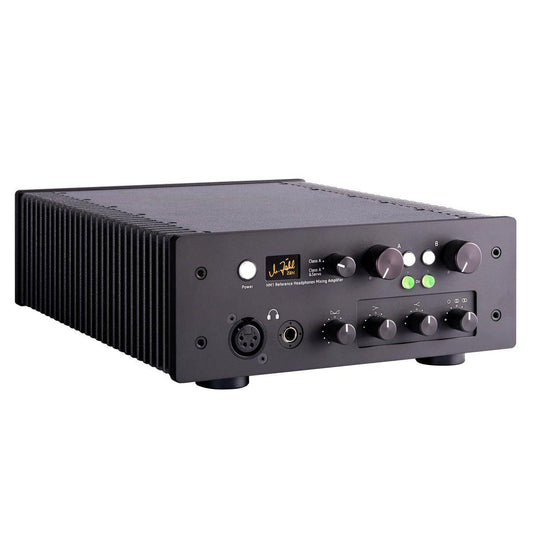
Zähl HM1 Reference Desktop Headphone Amplifier
Another product keeping its place on the list for 2025 is the Zahl HM1, the amplifier that continues to be my benchmark reference point and what I use for evaluation of all headphones and DACs I cover in review content.
The Zahl HM1 has some unique features not found on almost any other amplifier that have been an immense benefit to my own listening enjoyment, and ones that having owned the HM1 myself for a few years now, I’d struggle to live without.
Firstly, it offers two sets of analog inputs, each of which can be enabled or disabled, and have their volume controlled independently. This means I can do things such as directly AB’ing between two different DACs, or having one DAC connected to my PC to allow me to chat with friends in a call, whilst another DAC or even a vinyl turntable if you have one feeds your music to the second input.
There are also built in analog EQ controls, ones which measurably outperform the dedicated analog EQ devices which I’ve seen measured from other manufacturers, and this is likely no surprise given as the man behind the HM1; Michael Zahl, is most well known for his high end mixing consoles used by the likes of Nils Frahm, The Chemical Brothers and Aphex Twin.
Some of the features from his console and modules have made their way onto the HM1 as well, such as the stereo-base adjustment which uses analog domain mid/side processing (not crossfeed!) to increase or decrease the stereo width of any mix and allow you to tweak the level of spaciousness in your music to taste. I found that having this on the ‘+1’ setting was an outright improvement for almost all music when listening on headphones. Oh…and did I mention that all of the EQ and stereo-base adjustment features can be enabled or completely bypassed independently on each input too?
The HM1 is to put it simply, one of the two best solid state amplifiers I’ve had the pleasure of listening to. Being matched only by the MassKobo 465. Never have I heard an amplifier that was as utterly transparent, endlessly technically capable, and yet had none of the drawbacks in terms of leaning into being a tad ‘bright’ that I would otherwise expect from an amplifier delivering such incredible levels of detail.
But there is also one feature that means the HM1 is in some ways “two amps in one box”, which is the ability to run it as a full Class-A amplifier with feedback correction, or to run it as a completely feedback-free amplifier.
The HM1 without feedback objectively performs better than any other zero-feedback amplifier I’m aware of, not just in outright THD but also in how consistently it behaves when current output increases.
Disabling the feedback gives you a sound signature that unlike the “I can’t tell if this is an amp or a cable” level of transparency offered by the Class A+Servo mode, instead gives just a small hint of warmth to the sound. Enough to satisfy that desire that springs up now and then when I’m wanting to listen to music in a more relaxed mood or setting, but not so much that I could describe it as making the amplifier sound ‘coloured’ in presentation or leave me wanting to turn it back to feedback enabled after a few tracks. I find myself listening to the amplifier with each of these options about equally as each option suits a different mood.
I could write at any length about this amplifier because every aspect of it, from the sound, to the features, to the obsessive level of care that every aspect of its design exhibits, is simply in a class of its own. Even small things like the fact that parts for this amplifier are heavily binned, meaning only the top few % of a batch of capacitors for instance actually ends up being put into a unit. Or the fact that there are entirely separate power supplies for each channel, AND another just for the logic circuitry.
Being limited to only 50 units worldwide per year, and with an eye-watering pricetag, it’s one that few will be fortunate enough to own. But if you are in the position to get ahold of an HM1, it is currently where my amplifier journey has led me to and I’ve yet to hear anything else that tempted me away from it.
The HM1 does now also have a little brother; the H1.
This amplifier is exactly the same amp itself as the flagship HM1, just without the input mixing, preamp, and EQ features. Instead focusing solely on use as a headphone amplifier itself and in doing so making the device slightly more compact with the PSU moved internal to the unit, rather than being in a separate box. For those that are wanting what to my ear still remains the most truly honest, transparent amplifier I’ve yet heard, but don’t need the additional features offered by the HM1, the H1 could be a more attractive option.
DAC/Amp Combo Units
Entry Level (<$300) - CrinEar Protocol Max

CrinEar Protocol Max
The Protocol Max already claimed a prize in the budget DAC category, but given as it is also a fairly powerful amplifier for the dongle form factor, able to drive the majority of headphones without issue, it takes a second prize as my recommendation for an entry level DAC/Amp combo for use either on the go or at your desk.
For more information, please head up to the Entry-Level DAC category for full thoughts on the device. The only additional piece of info that is important to add in the context of an amplifier is that the protocol max relies on device/software volume control rather than having one of its own, and therefore you will want to ensure that you have a reliable way of adjusting the volume on your phone/PC OS.
Mid-Tier ($300-$1000) - JDS Element IV

Click here to visit the product page for the JDS Element IV
Another product returning to my recommendations for 2026 is the JDS Element IV, not solely because of its performance and featureset remaining extremely competitive, but also thanks to some updates and improvements JDS has made via free software updates that bring even more to the table than this offered previously.
A sleek, and seriously impressive desktop combo, it has the ability to drive just about anything thanks to its 3W @ 32 Ohm output power capability, and 85dB SNR @ 50mV making it ideal for users of sensitive IEMs too.
Backing this up with an impressively neutral tuning and level of technical performance that left me struggling to think of products I’d consider an actual ‘upgrade’ without spending three times as much, it really did leave me in a position where I had to say that under $1000, there really isn’t much reason to get anything else!
But beyond the impressive build, sound quality, and excellent objective performance, what really completes this package and earns it this spot on the list is the EQ functionality offered by the Element IV.
Controlled entirely via a web-panel, with a sleek, responsive UI, you can easily make adjustments to your headphone’s tuning and tweak or correct things to taste. You can even save, share, and import presets from friends via a URL, or from sources such as squiglink or text files.
Recent firmware updates have added support for an increased number of EQ bands, and a mid/side processing feature which to my ear is a far more preferable alternative to typical crossfeed for providing a greater sense of soundstage in headphone listening.
An excellent DAC, an excellent amp, and features that I really wish were present on more products at any pricepoint, the Element IV is a no-brainer choice if you’re looking for a combo under $1000.
High-End ($1000-3000) - Hold up!
This entry is a little unorthodox….
There are plenty of excellent DAC/Amp combo options available at lower prices. My Chord Mojo 2 has been a go to for on the go use ever since I first listened to, and then purchased one several years ago, and the JDS Element IV as described above is a feature and performance value king. But as you look to the higher end of things, the challenge is that in many instances, you don’t in my experience get all that much of a benefit unless you’re specifically looking for features alone.
The previous year I had recommended the Fiio R9 for this slot, an android based DAC/Amp combo which also allows you to control and play music directly from the device as if the unit itself were a phone. I still think highly of the R9, and if you DO wish to spend more than $1000 on a DAC/Amp combo, that would indeed be my recommendation. However, the reason I’m suggesting holding off is because I feel I would be doing the reader a disservice if I didn’t state clearly that in this price bracket, there are many better options if you opt to purchase separate units. A pairing such as a Singxer SA-1 with an Eversolo DAC-Z8 would bring better sound quality than the R9 for a similar price, and the R9 itself is only a relatively small improvement over the JDS Element IV unless the android based UI itself was of significant value to you.
Therefore, my recommendation in this price bracket is to either hold off until you’re able to make the jump to the next bracket up, OR; seek out a separate DAC and amp pairing, rather than a combination unit. You will get better performance, even when going for still very compact units such as the SA-1/Z8 combo that take up little more space than the R9 does.
Summit-Fi (>$3000) - Ferrum WANDLA HP

The original WANDLA was a DAC that impressed me so much I reached out to Ferrum to ask if we could work together to develop the WANDLA GoldenSound Edition.
And recently, Ferrum has taken the existing WANDLA design, and added a new dedicated headphone amplifier to the unit.
I have to be honest, I was not the biggest fan of the Ferrum ERCO V2, and so I was a little unsure what to expect in the WANDLA HP. Having had the chance to compare it at the Warsaw AV show to the ERCO V2 in a setup that allowed me to connect just the DAC portion of the WANDLA and ERCO V2 to the same amplifier, and then try just the WANDLA DAC into the analog amplifiers within the ERCO V2 and WANDLA HP, I was quite impressed to find that not only was the WANDLA a clear and substantial improvement as a DAC from the ERCO V2, but that the amplifier in the WANDLA HP was also quite a substantial improvement from the amplifier in the ERCO V2.
The WANDLA HP keeps everything I adored about the WANDLA as a DAC, in fact the mainboard has not changed other than adding some ports and relays to connect the amplifier daughterboard, but adds an amplifier that is extremely impressive in its own right.
With a continuous output power of 3W @ 32 Ohm, (although it can do more for short durations as music demands) it can quite comfortably power even very demanding planars. I did most of my auditioning using the notoriously difficult to drive Hifiman Susvara, and the sound was absolutely stunning. Beautifully transparent, enough that I’d cautiously say I may even prefer it as an amplifier alone to the Singxer SA-1 V2, and with a ferocious level of grip and authority with more demanding electronic tracks on the Hifiman Susvara, something that I find is the first thing to fall apart on lesser amplifiers.
The WANDLA HP combines one of my all time favourite DACs with a seriously impressive amplifier. Then adds features like the choice between analog and digital volume control, or the spatial enhancement if you opt for the GSE upgrade later, and leaves it as currently the best DAC/Amp combo device I’ve tried.

