Symphonium Zenith: 4BA Slays All Day
Join Precogvision as he discusses Symphonium's Zenith, their ultimate 4BA collaboration with Elise Audio

Introduction
The four balanced armature IEM. Over a decade ago, South Korea showcased the capability of this humble driver architecture with the Hidition Viento. The Viento stood steadfast, a paradigm of efficiency, in an arms race of hybrids and high-count BA IEMs. But the years passed. And just as it seemed that the industry had finally caught up, a small Singaporean firm - Symphonium Audio - released the Helios in 2021, which gave the platform the firepower for the modern world.
That was five years ago. Subsequent IEMs from Symphonium - namely the Crimson and Europa - were what I’d describe as excellent but more iterative in nature. Despite this, the Symphonium team has stuck to their guns and finally released the Zenith ($1800) in collaboration with Elise Audio. According to them, this is the peak of what they can eke out from the driver configuration. Can the Zenith redefine the platform like the Helios did? Let’s take a closer listen.
All critical listening was performed using the stock silicone tips and cable. Listening was performed off of the Apple USB-C dongle, Questyle M15, HiBy R6 Pro II, and Lotoo Mjolnir. As always, what follows are my honest thoughts and opinions to the best of my ability.

The Tangibles
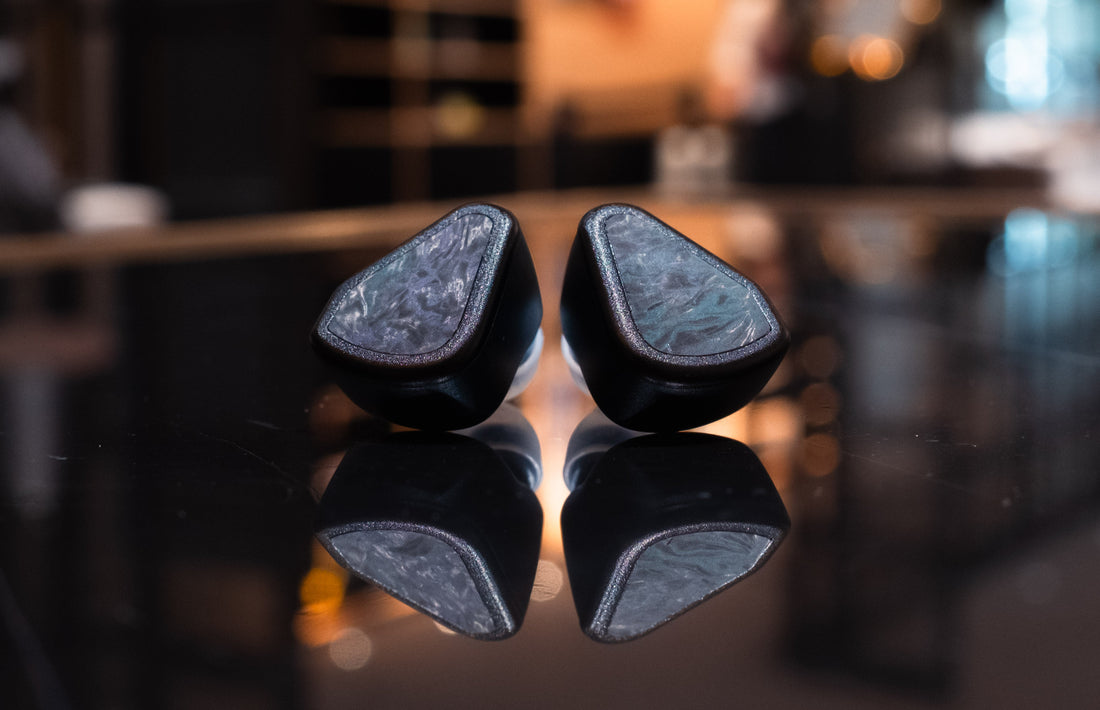
Symphonium continues to iterate on the original (fairly uncomfortable) design that the Helios sported; these incremental improvements are all realized in the Zenith. The Zenith maintains the triangular, industrial design composed of aluminum and accented by a deep blue and purple faceplate. But unlike most balanced armature designs, the Zenith has venting. It’s cleverly integrated through the connector pin; the connector pin has a small gap adjacent to the faceplate. In totality, with the improved angularity of the Zenith’s nozzles and the medium-sized shells, I find the Zenith is aptly-suited for long-term listening. I had no issues listening to it for a 5+hour plane ride.
My biggest gripe with the Zenith’s build would have to do more with the cable. The pins on the cable are extruded, and the Zenith itself lacks recessed connectors. I’ve noticed that the pins are more susceptible to being squished when you put the IEM in the case, and they’ve bent slightly for me on more than one occasion. That aside, the cable is purely a friction-fit for the interchangeable 3.5 and 4.4mm terminations - if your source has a tight connection, and you pull on the cable a bit lower, you could inadvertently leave behind the swappable termination.

Sound Analysis
The bass of the Zenith is heavily inspired by the Crimson and Europa; it nestles between the two in terms of quantity, emphasized and well-above neutral nonetheless. Quantity aside, the Zenith’s bass maintains the transient characteristics that defined its lineage: the snappy, rigid attack and controlled, curated bloom are all there.
But to my ears, the Zenith has a hint of extra bounce, dynamism to the way it presents bass notes, possibly due to its newly vented nature. On Babymonster’s “Choom”, for example, it’s like hearing another layer of air settling around bass notes as they drop, that comes and goes just as quickly. It’s different from the ThieAudio Valhalla, which has more size and a greater sense of finality to bass notes, but it’s on the same playing field - I’d say nearly top-tier - in terms of quality.
Not much has changed about the midrange of the Zenith. It has the classic rise from 1-3kHz (decidedly not New Meta), a more colored 2.5kHz pinna notch, and a gently elevated 3-4kHz region. You can expect vocals to rest slightly further back in terms of presentation. However, in terms of sheer loudness, they still sound present - equally so between both male and female vocals - and highly intelligible. The Zenith is not a midrange specialist; however, its midrange nestles comfortably between being colored and balanced.

The treble of the Zenith is defined by a series of micro peaks throughout. It’s clearly inspired by the Subtonic Storm, yet playing in its own wheelhouse. For context, I generally associate the Storm’s treble with being rigid, heavy, even intense depending on source pairing. The Zenith, though, leans more sparkly and playful with slightly more energy past 15kHz. Its peaks are spaced such that they lend vibrancy without sacrificing detail or inducing fatigue at louder listening volumes to me. Those with more sensitive tolerances could find this to sound somewhere between fuzzy and brittle - especially around 14kHz - depending on tip pairing.
The Zenith’s tuning is strong, but it’s also decidedly colored, and I can see it not being for everyone - especially listeners who prefer something either more restrained and neutral, or more immediately energetic and exciting. If you enjoy IEMs like the YU9 Que or 64 Audio U4S, the Zenith plays in a similar lane. It’s usually not the type of IEM that instantly “wows” you, but one you find yourself coming back to as you hear more sets and realize how well it occupies that middle ground for a colored tuning. I would not necessarily think of the Zenith as a clear upgrade in raw tuning, especially compared to the Que.
But do understand that you’re getting a noticeable step-up in technical performance and presentation from the aforementioned Que and U4S. In this regard, I feel like I could copy and paste the caricature language from reviews we’ve all seen of many lesser IEMs. It’s unfortunate that these types of overzealous reviews have done a disservice to describing IEMs like the Zenith that are the real deal.

In any event, the Zenith’s presentation is more or less “holographic”. It has exceptional lateral width, solid depth, and the rare, occasional sensation of sounds subtly localizing from behind the ears. Imaging is incredibly distinct; on occasional instances, I’ve had instrument lines pop from the mix that I haven’t heard previously.
I would mostly describe the Zenith as tastefully nuanced. It's not an IEM that creates detail through sheer crispness of decay transients. There’s another layer past that, a texturing from the micro-peaks in its treble, that sounds quite intoxicating. It’s like you’re savoring the cookie-crumble layer of a well-baked pastry and the taste hangs on your tongue fleetingly. It is ever-so-slightly artificial - I would point to the upper-treble boost for adding this quality - but the detail it ekes out is difficult to argue with.
Dynamics and volume scaling on the Zenith are strong points. I enjoy cranking the volume on the Zenith and it holds up excellently at louder volumes; however, it also sounds good at quieter listening volumes. To me, it has an equal sense of contrast across the big picture and individual frequency bands when zoomed-in.
Against the best of the best, IEMs like the Subtonic Storm ($7300) and the Mysticraft HEX ($9800), I would say there is a noticeable gap for technical performance. The HEX has more scale to its staging and crisper attack transients; the Storm has superior micro-dynamics and more consistently draws my attention to sounds previously unheard. If I hadn’t heard the Storm or the Hex before, my assessment of the Zenith might be more enthusiastic, but I’ve compared all three IEMs in direct A/B. Comparatively, the Zenith comes closer to sounding as detailed as my Annihilator 2023 (bearing in mind that they’re IEMs with very different sound signatures). The Zenith plays closer to the $2000-3000 range to my ears, which is still nothing to scoff at.

That in mind, a more fair comparison is versus the ThieAudio Valhalla which is priced similarly at $2,000. I find the Valhalla and the Zenith to be the offspring of distinct ideologies in both form and sound. Let’s start with the sound - the most obvious difference on paper is driver spam versus efficiency.
In the ear, presentation-wise, the Valhalla has excellent vertical scale; it sounds grand and cavernous. However, it’s almost like you’ve intentionally been placed in a specific acoustic environment; a fixed space with the artists and your music. The Zenith’s soundstage, on the other hand, feels more expansive and more black. It stretches further outward, especially toward the extremes of the stage.
The Valhalla also has more meat to its transients. There’s a pleasant fuzziness to the Valhalla’s sound, equal parts warmth from the thicker lower-midrange and the shimmer up-top. It’s like you don’t have your glasses on, and you’re looking at a pretty girl. Everything is a little softer, a little more romantic, and maybe even more flattering. But the Zenith is like putting the glasses back on. It has a cleaner sense of precision, rawness, and more authenticity. You’re seeing the girl with your glasses on and she’s still pretty.
Overall, the IEMs are equally immersive and I bounce between the two depending on my mood; they have two very different approaches to how they present music. My general sense is that the Zenith's level of technical performance and ability to “scale” is higher and it’s more finicky with sources, although both sounded excellent using just the Apple USB-C dongle (and this is what I used to perform the majority of my listening). These are not IEMs that require expensive/fancy sources to sound good.

The Bottom Line
When I first entered the hobby 5-6 years ago, the most expensive IEMs were around $2000 and this was where peak performance - “the best sound in the world” was. Since then, I’ve watched IEM prices skyrocket, which could loosely be justified by some of these new IEMs taking up the mantle of “the best” and taking sonic performance to new heights.
I think this tacit hierarchy stands. The Symphonium Zenith is not the zenith of all IEMs, and it’s not suddenly de-throning the insanely expensive IEMs that guard this status. But the zenith of 4BA IEMs, or the zenith of IEMs under $2000? That’s where I start seeing a compelling argument for this IEM.
Overall, the Zenith’s a wake-up call for a lot of other IEMs that were, for lack of better word, riding on the coattails of the wave of price increases. The Zenith would be one of my top picks for listeners indexing for subjective technical qualities, and who don’t want to pay the premium attached to IEMs like the Subtonic Storm and Mysticraft Hex.

