Softears EDGE: Not Another Basshead Set
The Softears EDGE is a unique departure from Softears' designs and promises to deliver audiophile experiences in everyday style.

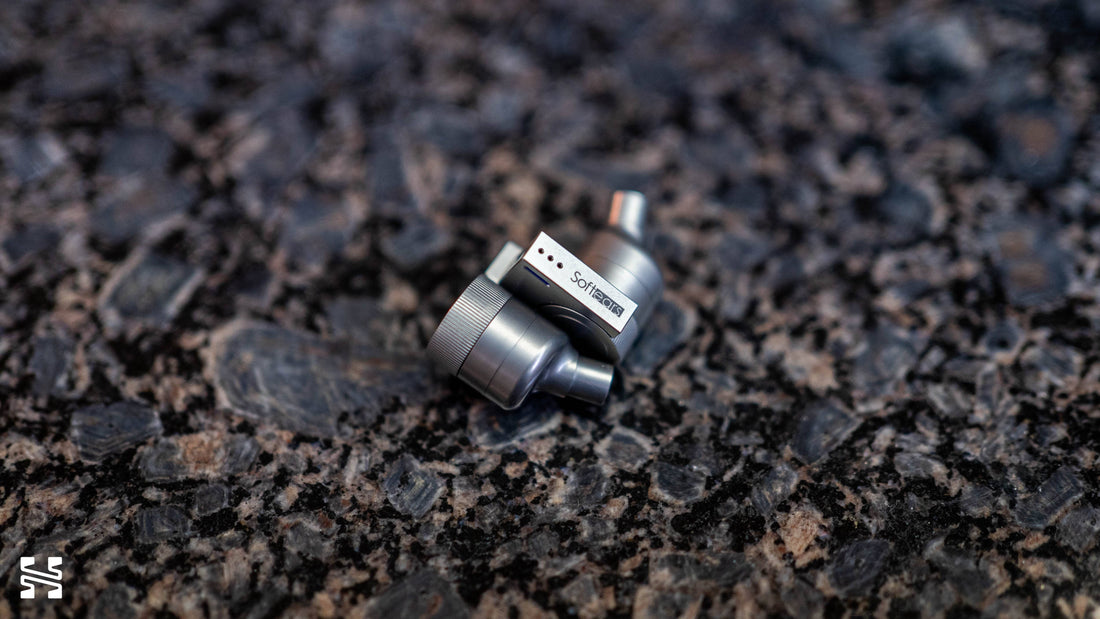
Introduction
The world of IEMs moves fast. Every brand seemingly has a new model each month. Softears is an exception. The lesser known (but arguably more respected) cousin of MoonDrop, they seem to take their time between releases, focusing on developing a unique aspect that defines each product.
One such release is the $600 Softears EDGE, a single dynamic driver IEM that’s part of their new “LS” (Lifestyle Series) which Softears positions as a line-up meant to blend the audiophile experience with everyday style. To put money where their mouth is, they’ve crafted the EDGE as a homage to the Sigma BF mirrorless camera. That’s one half of their promise. Now let’s see how it sounds.
Source(s) Used: Ferrum ERCO, Apple USB-C dongle, FiiO Q7
What we like
- Big, bodied bass
- Unique Sigma BF camera inspired shell design
What we don’t like
- Bass bloat that can creep into the lower mids
- Price

What in the Box?
Inside the box, you get a standard set of accessories.
- The Softears EDGE - These shells are made of a titanium alloy with rather unique geometric features, both internally and externally. It reminds me of the Tin HiFi T2 from back in the day.
- Two sets of tips in S/M/L - These come in the UC (Ultra Clear) and standard silicone variants.
- A 2-pin 2-core silver-plated copper cable - It’s quite a good cable with great overall ergonomics. No cable noise, soft and pliable, and only a bit of cable memory. No interchangeable terminations though.
- A cleaning cloth, little fabric carrying case, and cleaning brush.
The most interesting thing about the EDGE is its internal design. To get around some of the acoustic limitations of single dynamic driver designs, Softears engineered an internal labyrinth structure to help with internal resonances. How well it works in practice is what we’ll discuss in this review.
Comfort wise, despite the EDGE’s deliberately angular design, it works well enough. The nozzle has a diameter of 5.5 mm which is nice to see as most IEMs are pushing past 6 mm now. The nozzle is also ergonomically angled so it fits into my ear canal without issue. I don’t feel the shell of this IEM touching my ears much at all.
Tips do matter more than normal with this IEM. I usually like to start with the AET07 tips but found that they didn’t give me a good seal. So I switched over the stock standard silicone tips which fit just right.

Sound - Objective
Here are frequency response measurements of the Softears Edge calibrated to Headphones.com’s new IEM Diffuse Field (DF) HRTF. Preference bounds are depicted in the grey region. In extremely simplified terms, if the frequency response is within the bounds, it’s likely to sound balanced. And that means it’s most likely to be preferred by the average person - hence the name, preference bounds. That said, 1) You are not an average person; and 2) There’s no reason why you can’t enjoy multiple types of tunings. It’s a question of probability.

Here is the raw graph which is a different visualization of the same dataset.

Sound - Subjective
Bass
Bass is the dominant aspect of the Softears EDGE. It’s at the forefront of everything. No surprise, really, when you look at the frequency response graphs and see just how much of it there is. The other thing to note is how the bass shelf reaches far into the lower mids, ending only at 400 Hz.
At first impressions, I didn’t actually get a sense of complete and total mud. The bass quality itself isn’t bad, especially when you get the right tips on. It’s boomy, but there isn’t too much pillow-yness here. I’d actually say it’s fairly firm and weighty for what it is.

The problem is more that bleeding into the lower mids that makes that region around 400 Hz feel “blergh”, for lack of a better word. Even before I looked at the graph, I knew there was going to be a lot of that bass bleed there. But what I didn’t expect was just how much bass was present in the graph. The EDGE comes off as very bassy, but not obnoxiously, disgustingly so. Maybe I’m a basshead.
That feeling of blergh also did subside with extended listening as my brain adapted to the sound. When switching from something more neutral/reference like the CrinEar Daybreak, I absolutely hear that bass shelf protrusion into the mids. It’s bloat. It’s like the front of a wave creeping past where it should. But with more ear time, my initial distaste for it faded and I could better appreciate the sub and midbass presence it brings to the table.
One funny note is if a track is engineered to already have enormous amounts of bass (e.g. some pop songs), the EDGE can take it to truly hilarious levels. It's rare, but when it happens I can’t help but laugh at the absurdity.

Mids
Because the EDGE’s lower mids have been subjugated by the bass, its upper mids need to pick up the slack. I think it does a fairly good job. There’s sufficient presence for vocal clarity and forwardness without going overboard or being shouty. I wouldn’t really classify this IEM as warm per se. While it’s obviously warmer than a less bassy set, I’d say it’s more of a bodied, deeper sound highlighted by certain instruments than that overall warm, lush, rich type of atmosphere.
Like many older IEMs not tuned to the “new meta” style, the EDGE has a slightly earlier pinna rise and relaxed 3 kHz peak. Depending on the rest of the IEM’s tuning, this can come off as a bit nasally. But on the EDGE, I think it works fine. Partly because there’s an abundance of lower mids, partly because the upper mids continue to rise into the lower treble, adding that extra sense of clarity to help cut through the bass. As such, I don’t really have that many complaints with the timbre. Yes, the bloat will always be a problem if you look for it. But in general, the EDGE’s midrange is competent enough.

Treble
The EDGE’s lower treble adds a good bit of sharpness and crispness to lift its overall tonality from the mud. I don’t find this area to be overly peaky or harsh in any way. It’s just the right amount of vibrancy to complement the bassy tuning.
Looking at the upper treble, there is a peak that appears around the 12 - 14 kHz region. In principle, I have no issue with extra upper treble energy - it further adds air to balance out the bass. But I do think the way it’s done on the EDGE is a little overdone. It’s primarily an issue with instruments like the crash cymbal, where occasionally there’s a big bright splash when notes land. In an otherwise bassy listening experience, these bright spots take me out of the experience. Even just a slight taming of 2 dB or so would be sufficient. I guess that labyrinth that Softears engineered wasn’t able to fully eliminate all resonances.
As a whole though, I think the EDGE’s treble works well with the rest of its tuning. It’s nothing amazing or particularly special, but it works. Frankly, this is all I’m looking for. With more esoteric tunings like this, it’s easier to butcher the treble response. The EDGE goes for something reasonable and that’s good enough.

Presentation
The EDGE has a primarily intimate stage presentation. Most instruments are clustered within the center image. However, that’s not to say it doesn’t have any stereo width. Complementary notes such as trailing cymbal crashes or little electric guitar runs are placed towards the left and right ears, giving a natural sense of spacing. Despite the more centered image generally, I didn’t get the sense that the EDGE is a claustrophobic, congested IEM. Like many IEMs however, there is next to no stage height and depth is shallow.
Other perceived “technicalities” like resolution or layering are OK. Nothing particularly stands out. Dynamically, the bass can feel big, but it shoots itself a little in the foot because of the lower mids bloat. The bass quantity overflows and blurs the transient edge that defines dynamism. The EDGE’s treble helps compensate perceptually, but it’s an adjacent fix, not a direct one.

Comparison: CrinEar Monolith
It may seem odd to compare the Softears EDGE to the pure basshead CrinEar Monolith, but the more I listened to the EDGE I realized it has quite a few similarities and this comparison helps give a better perspective on the EDGE itself.
Here’s the graph of the EDGE vs. the Monolith. They’re almost neck-and-neck in the bass. Yet because of the rest of the tuning, these two IEMs are significantly different from one another.

I think the first thing to note is where the bass shelf ends for both IEMs. The Monolith ends at 300 Hz while the EDGE ends at 400 Hz. This difference is what makes the Monolith a “very bassy but otherwise normal sounding IEM” and the EDGE a “this IEM has bass bloat”.
The other key thing to note is how the treble is shaped. Because the Monolith otherwise follows a very safe “new meta” style of treble response, there’s no vibrance or brilliance in this region. Once again, it leads to a “very bassy but otherwise normal sounding IEM” feeling. The EDGE on the other hand purposefully injects energy here to accentuate certain notes and harmonics, drawing out extra sparkle and clarity. This is what gives the EDGE character beyond simply being a basshead IEM. As mentioned earlier, this treble helps perceptually compensate so it doesn’t feel like it’s drowning in bass. Call it V-shaped if you want, but I think that’s a bit of a reductive take.

That said, this discussion is rather moot as the Monolith is sold out. It also costs $400 vs. the $600 of the EDGE (or $500 on sale). Either way, the point I wanted to make was that despite having copious amounts of bass, they present quite differently in their sonic characteristics. At no point did I think I was listening to a different flavor of the Monolith. I only picked this comparison while doing measurements and coming to the sudden realization that the EDGE was actually bassier.

Should You Buy It?
Not really. It’s funny. I went from a clear no, to a not really, to maybe, then finally back to not really. Something about the Softears EDGE had endeared me to its sound. But when I take a step back to think about what it costs and what it offers, it’s just not worth $600. Maybe like $300. There are countless options out there if you’re looking for something colored and fun. Buying the EDGE seems like paying a premium for the Softears industrial design. Ultimately, while I’ve come around to appreciating the EDGE for what it is, it’s very hard to bring myself to say the words “You should buy the EDGE instead”.

