AUNE AR3000 Review: The New De Facto
Not every day does a new headphone become the de facto recommendation. The AUNE AR3000 does.

Introduction
For as long as I can remember, the de facto starter audiophile headphone has been the Sennheiser HD 600 (or HD650/6XX). While competitors had always existed, the HD 600’s popularity remained unshakeable. Yet for those paying attention, there’s been a quiet revolution in headphones aiming to shake the HD 600 off its throne. The recent slew of new entrants such as the FiiO FT1 Pro, Sony MDR-MV1, and even the HyperX Cloud Alpha Air are legitimate alternatives to Sennheiser’s mainstay.
Now, we add the $250 AUNE AR3000 to that list. The little brother to AUNE’s much acclaimed flagship $1,400 AR9000, it promises to bring the same engineering down to a more accessible price. Let’s see if the AR3000 has what it takes to finally replace the HD 600.
Source(s) Used: CrinEar Protocol Max, Fosi Audio ZH3
What we like
- Exceptional low-end extension for an open-back
- Excellent midrange and well-controlled treble
- Extremely competitive pricing
What we don’t like
- Wider ears may touch the angled drivers inside of earcup

Build and Comfort
Inside the box, you get the AR3000 and two basic 1.5 m cloth cables terminating in 3.5 mm and 4.4 mm. Nitpicky, but I wish the 4.4 mm was 3 m. I’m also personally never a fan of nylon braided cables. This one is a little stiff with cable noise. There is also a 3.5 mm to 6.35 mm adapter to cover your bases.
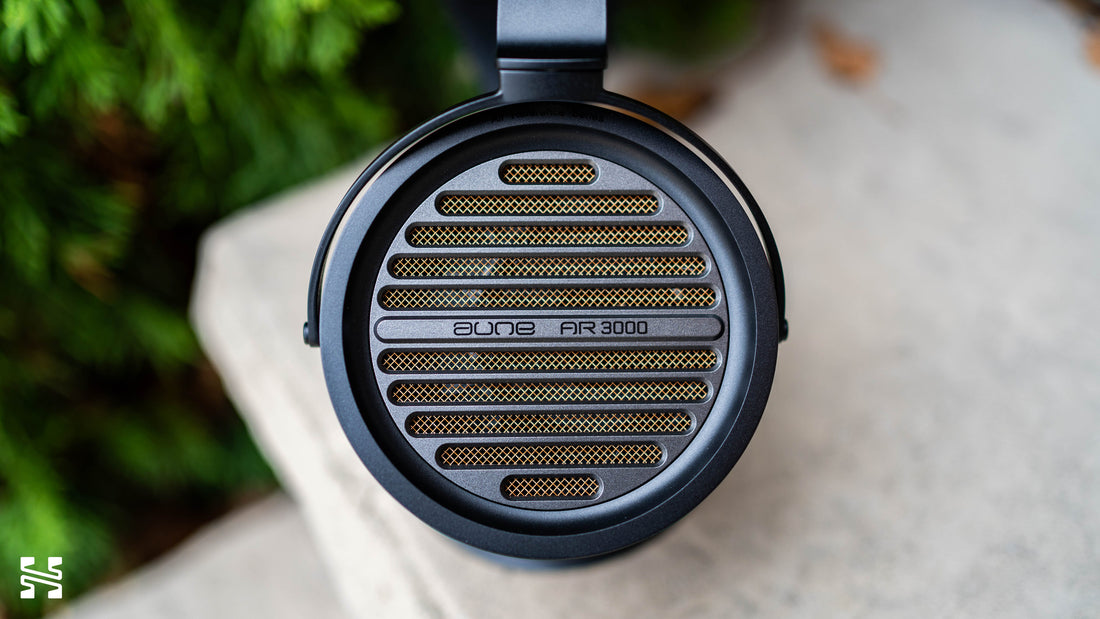
The design of the headphone itself is nearly identical to its brethren. There’s a metal headband and yokes, which is great to see. The clips holding the suspension strap are plastic, as with the cups, but it doesn’t feel fragile. The suspension strap is wide and helps distribute weight evenly, though I do wish it had just a bit more padding to it.
The AR3000 utilizes 50 mm drivers and the circular cups are reasonably sized to fit over the ear for most ears. The pads are quite angled however, as with the drivers inside. Here is where the one complaint comes in: Depending on how wide your ears are or how you like to sit the headphones on your head, it may touch the driver covers inside the earcup. For me, if I wear the AR3000 at a certain angle, my ears graze the cover. But in general, I don’t have an issue when I have it at a more regular angle.
The pads are perforated hybrids with breathable cloth touching your skin and leather on the circumference. While they are plush, because of the aforementioned angle, the front of the pads has a lot less room to compress than the back. Once again, this was not an issue for me. I wore these headphones for about 2 hours straight the first night I got them in.

Sound - Objective
Here are frequency response measurements of the AUNE AR3000 calibrated to Headphones.com’s Diffuse Field (DF) HRTF taken on the industry standard B&K 5128 rig. Preference bounds are depicted in the grey region.
In extremely simplified terms, if the frequency response is within the bounds, it’s likely to sound balanced. And that means it’s most likely to be preferred by the average person - hence the name, preference bounds. That said, 1) You are not an average person; and 2) There’s no reason why you can’t enjoy multiple types of tunings. It’s a question of probability.

Here is the raw graph which is a different visualization of the same dataset.

Looking at the measurements, there’s a few interesting things to note.
- That’s a lot of bass. The AR3000 has more bass than 90% of open-back headphones on the market. It peaks around 50 Hz before starting to roll-off. Looking at how it steps just a little past the preference bounds, some might find it just a tad too bassy.
- The midrange is nicely controlled, if a little relaxed.
- The treble is interesting - in general, it’s similarly relaxed except for a peak around 7 - 8 kHz. How noticeable that peak will be is going to be the key question. On the upside, it’s within the preference bounds still.
- Overall, one might expect the AR3000 to be a warm, bassy sounding headphone with a present but polite treble.
- There looks to be some positional variation in the midrange from 1 - 3 kHz of about 3 dB. This is likely due to the angled drivers where consistency is important.
And here is how my AR3000 unit actually looks on my head. This was taken using open canal in-ear microphones AKA microphones-in-real-ear (MIRE) measurements. This is how the AR3000 will sound on my head vs. the B&K 5128 is a model of the average human head, and is thus a more accurate reflection of my review. I’m using a 10 dB downwards tilt as a reference point as this is, generally speaking, what an average person prefers.

Note: Keep in mind that left and right measurements will necessarily be a little different - not only is there seating variance but also because our heads, ears, and sides of our faces are naturally asymmetrical and affect how headphones couple to the head (HpTF variation). That said, that channel imbalance in the midrange is noticeable to me. I hear a very slight right side bias.
And here it is with and without glasses.

For those unaware, wearing glasses can affect the sound of a headphone due to a break in the seal. For the AR3000, it’s a negligible amount. You lose less than 1 dB at the lowest octaves. Of course, this will depend on how thick your glasses are, but for mine it’s not an issue at all.
Lastly, here it is across a few different seatings. Given that the glasses measurements didn’t change too much, I’ll add it in here as well.

Interestingly, the positional variation isn’t actually that bad. At worst, it’s only about 1.5 dB in the mids. This is possibly because I’m forced to wear it consistently due to the angle in the cups.

Sound - Subjective
Bass
The bass of the AR3000 is a rarity for open-back headphones. It’s exceptionally bassy for an open back, and importantly, this is good quality bass. The way the bass is tuned creates a healthy low end that gently rises from the lower mids before ramping up into the midbass where it finishes strong right at 60 Hz before it starts to taper off.
The best way I can describe the AR3000’s bass is that it’s meaty. While it does have subbass rumble, it’s not the primary focus. Instead, it’s the slight elevation in the midbass around 60 - 150 Hz that really gives it that meatiness. This makes the AR3000 a boomy rather than punchy headphone. Notes have a firm, rounded characteristic as opposed to a tight, defined leading edge. Personally, I wouldn’t call it “slam-y” as it feels more weighty than explosive. The AR3000’s bass is not muddy in any way. Notes are never lost. It’s really that midbass presence that gets emphasized in kick drums and floor toms. Like I said, meaty. That’s the most accurate way to describe it.
When compared to a regular open back with their typical bass roll-off, the bass quantity can be downright surprising at times. It’s like the sudden realization that “Hey, I can actually hear the bass now!”. It reminds me of when I first added a subwoofer to my bookshelf speakers - I didn’t lose any of the clarity I was used to, I just got bass added to it.
Of course, this isn’t to say that the AR3000’s bass sounds like a subwoofer. It does not. In fact, this is where my biggest nitpick about its bass comes in - it feels more like sheer quantity rather than raw physicality. Regardless, all this bass is very much welcome. Some might call it fun; I would almost say it’s a necessity.
Simply put, the AR3000 is one of the few open-back headphones that can deliver a substantial but quality bass experience. The fact that it’s offering this at $250 is enough to make this a compelling headphone.

Mids
The AR3000’s midrange is nicely done. It’s definitely a warmer headphone as its bass shelf never dips in the lower mids while it’s pulled back a tad in the upper mids around 1 - 2 kHz. However, with sufficient energy in the ear gain region at 3 - 4 kHz, there’s sufficient clarity for anything you throw at it.
While I wouldn’t call it a midrange specialist (as its bass is its primary weapon), the AR3000’s midrange is just about as good as any other headphone out there. There will be some user preference to be sure, but I never felt like the AR3000 was lacking in midrange timbre somehow. Vocals, guitars, pianos, strings, they all sound great with a slightly thick coloration.
If you’re looking for a headphone focused in the midrange with soaring vocals, the AR3000 isn’t the right headphone. The midrange is thoroughly mixed in with the rest of the track rather than being highlighted. It sits in a great Goldilocks area for tonal balance.
Treble
In general, the AR3000 is not a bright or crisp sounding headphone. There isn’t any sparkle or shimmer here. On one hand, this means it’s a safe sounding headphone. On the other hand, if you crave treble brilliance and vividity, the AR3000 does not have it.

It starts in the lower treble where I find it subdued around 4 - 6 kHz. This is the primary region where you get that crisp, sharp attack of the hats and cymbals. And it’s not just the hats and cymbals - a few other instruments depend on this region for definition. The crack of the snare drum, for example. Or the delicate plucking of the acoustic guitar strings. While the majority of these notes live in the lower frequencies, it's the upper harmonics that give them character. On the AR3000, that character is reserved.
In the mid-treble, this is where the data starts to show one potential point of concern. That is the ~7.5 kHz peak. On the B&K 5128, it’s a sizable peak especially when contrasted with dips on either side. We can see it in my MIRE measurements as well, though perhaps not quite as dramatically.
Personally, I don’t find this peak to be a problem at all. I don’t find it sharp or wincing in any way. In fact, outside of certain test tracks I probably wouldn’t even have noticed it beyond the mid-treble having a tiny amount of incoherency. But as with all headphones in the treble, your mileage may vary.
I would say that if the midrange wasn’t the focus of the AR3000, the treble is even less so. It’s present, it’s safe, and it doesn’t step anywhere out of line. To cast perhaps an overly critical word, it’s uninspiring. But for the AR3000, I think that suits it just fine. This is a headphone made for the widest possible audience.

Presentation
Let’s talk about perceived technical ability, or as I like to call it, presentation. Despite its open build, I don’t find the AR3000 to have a particularly large soundstage. If anything, it’s a little closed in. Similarly, imaging is alright at best. There is some stage depth but in general it has that left-right-center paradigm with vagueness in between. I wouldn’t call these weak points of the AR3000 but rather a baseline of many headphones.
In terms of resolution, the AR3000 is actually fairly competent. It’s able to pick up on a lot of smaller details that often get lost. Part of this is simply having enough bass quantity so you can actually hear those notes. The other part is its well controlled tonal response across the board that allows for more accurate, unmasked timbre. So while the AR3000 isn’t a forward or bright sounding headphone, it isn’t lacking in resolving ability.

Comparisons
Here are a few select comparisons for the AR3000. Since it’s not feasible for me to compare it against every headphone out there, here’s the key overarching takeaway I want you to have in the back of your mind: the AR3000 is not significantly inferior to any headphone when it comes to overall tonality.
Yes, there will be preferences, and yes, there will be specific treble interactions that may make the AR3000 a dealbreaker. But you can say that for any headphone. My point is that individuals have the capacity to appreciate and enjoy a range of sound signatures and the AR3000 fits somewhere in pretty much all of them.
Sennheiser HD 600
I’ll be completely frank: I don’t think there’s a clear case for taking the HD 600 over the AR3000 for most. For long time audiophiles, that may be sacrilegious to say. But after comparing them side-by-side for hours, let me present my argument:
The bass. One of the biggest complaints of the HD 600 has long been its lack of bass quantity and extension. The AR3000 handedly solves that problem. Switching between them, it’s so clearly apparent how much the HD 600 is lacking in the lower frequencies. While it’s able to do mid and upper bass, the HD 600’s subbass roll-off more than ever is its weakest point.
Now, to be fair, the AR3000 isn’t the first headphone with lots of bass. The Sony MDR-MV1 released a few years ago has just as much. But change is slow and I think the standard has been set. New open-back headphones will need a full bass region to compete.

The midrange and treble. I’ve personally never heard the HD 600’s midrange as that all together perfect representation of timbre that some audiophiles swear by. It’s very good, but it’s far from the be-all-end-all. On the flip side, the HD 600’s treble is often said to roll-off just as badly as its bass (AKA the Sennheiser veil), but that’s not true, especially with fresh pads. Perhaps against other bright headphones such as HiFiMan, but not in isolation. This is important because most of the discourse around the HD 600 references worn-in pads, which does darken the treble.
The AR3000’s midrange does not lose to the HD 600’s. I’m OK with either. If anything, the added warmth from the bass makes me lean towards the AR3000. For the treble, this is one area that the HD 600 wins due to a greater sense of brilliance, that’s all it is. Its treble isn’t much better in terms of quality.
Presentation. Both of them are close enough to one another that I don’t have a preference. I’d actually say the AR3000 is actually just a bit more resolving.
All that said, I do think there is one argument for the HD 600 if you’re looking to get into the “audio hobby”. And that is as a reference point. The AR3000 is far from the first headphone to compete with the HD 600 for sound. But arguably, the HD 600’s continued popularity is as much its history as its sound quality. The AR3000 isn’t going to overturn that overnight, nor will the HD 600 stop being a comparison point.
If you want to be a part of the “audio hobby”, the HD 600 still has merit as your first headphone to experience what countless reviews and forum posts talk about. But I think for everyone just looking for a good audiophile headphone to start, the AUNE AR3000 is the answer.
Sony MDR-MV1
A couple of years ago, Sony quietly released one of their best new headphones in a long time: the $420 Sony MDR-MV1. What made it notable was the amount of bass it had combined with a great midrange. Its biggest dealbreaker however was a rather hot mid-treble spot. It’s very much a warm-bright headphone.

In a way, the AR3000 feels like the spiritual successor of the MV1 (convergent evolution, anyone?). It takes the MV1’s formula but tones it down in both the bass and the treble. As a result, it sounds cleaner in the bass, reducing some of the excessive midbass body to open up the midrange while taming the troublesome treble region. For those reasons, I do think the AR3000 is a better headphone. I was quite surprised when I compared them - I expected it to be a tough fight but I walked away with a clear preference for the AR3000.
However, I should give credit to the MV1’s presentation. I find its soundstage to be a little wider and taller than the AR3000’s while its bass to be a bit better in definition, likely because of the increased treble it has.
HEDD Audio D1
The HEDD Audio D1 had been lauded as the upgrade to the HD 600 that everyone has been waiting for. To an extent, that’s true. It preserves much of the HD 600’s midrange prowess while adding proper bass rumble and texture. And that makes it a stronger competitor to the AR3000.
Personally, I could go either or with these headphones. Going back to the opening statement about how the AR3000 is not tonally inferior to any headphone, this is what I mean. I like the midrange of the D1 a little bit better and I do think the bass is of higher quality, but the bass quantity of the AR3000 is still a lot of fun and the warmer tilt of its mids is always pleasant.

Interestingly, if I do some treble nitpicking, I think the D1’s treble is a little less offensive. This is always going to depend on what songs you listen to and how sensitive you are to peaks. The D1’s treble is actually brighter than the AR3000’s, but the peaks are smoothened out relative to the dip-and-peak that the AR3000 has. It’s also shifted around to less troublesome areas for me. From a presentation perspective, I think the D1 is also a bit more resolving and the staging feels a touch more open.
This is one comparison I highly recommend you try if possible if you’re looking at either. That said, the D1 is $800 so it’s hard to justify it if it ends up being a sidegrade.
AUNE AR9000
Here’s a fun little history lesson: AUNE made its name with the original AR5000 headphone released 3 years ago. Though initially quiet, it picked up steam when a few hobbyists started to compare it favorably against the HD 600. AUNE capitalized on that momentum to develop their flagship $1,400 AR9000, where it spent those 3 years being fine tuned. The AR3000 meanwhile was a prototype afterthought at High End Vienna 2026 until a few reviewers gave some very positive feedback. Funny how that works.

Anyway, the AR9000 is a better headphone. The AR9000 has better bass quality - it’s more focused in the subbass, so there’s rumble and definition at the very lowest octaves. It has that raw sense of physicality I was missing from the AR3000 and it’s cleaner overall. The midrange is very comparable - the AR3000 is warmer and smoother while the AR9000 has some structure around 1 kHz that adds some body and character. The treble is where it gets dicey. I like the AR9000’s treble more in general - it’s more coherent and adds a good upper treble shimmer, but there is a bit of a 6 kHz peak on my head that can be a little rough. The staging is better as is the resolution by a small margin.
The obvious question is if the AR9000 is worth more than 5x the price. From a price-to-performance standpoint, of course not. But expensive headphones are luxury products where value depends entirely on the customer and there’s a dozen ways to work that argument. So I won’t. Instead, I’ll just say that while I think there’s a place for owning the AR3000 and the AR9000 together, at that price you may want to explore beyond AUNE’s flagship for different flavors.

Should You Buy It?
Yes. I think for all of the AUNE AR3000’s strong points, the greatest is actually its price. $250 is extremely, extremely competitive. It’s very hard to argue against it when the AR3000 is almost certainly better than anything cheaper and easily competes with headphones at or multiple times its price.
For someone looking to spend money and get their “first good pair of headphones”, the AR3000 offers all of that while respecting the budget. Tons of bass, excellent mids, inoffensive treble, and a competent perceived technical performance. And if you’re someone experienced in the hobby with several thousands deep in your headphone collection, $250 is a trivial addition.
Now, to temper this highly positive review a little - I don’t think the AR3000 will wow everyone. There’s no magic to this headphone. It’s not a headphone that’s first to mind when I want to really delve into and enjoy my music. I think part of being in this hobby is finding the things that fit the moods and music you find yourself in the journey of life. The AR3000 quite doesn’t evoke that emotional connection for me. But it is on the shortlist of headphones I’ll reach for.
Like many great things in life, the AR3000 does everything quietly well. That’s what makes it so easy to recommend. Or put it another way, there’s no reason that it shouldn’t be the new de facto standard. Oh, and did I mention it’s $250?
P.S.: For anyone more familiar with IEMs, the AUNE AR3000 is the Truthear Pure of headphones.

