Precog's CanJam SoCal 2026 Impressions
Precogvision's first-listen impressions of new, flagship, & prototype IEMs from CanJam SoCal 2026, featuring the 64 Audio Ocean, ThieAudio Vera, and standout YU9 prototypes.

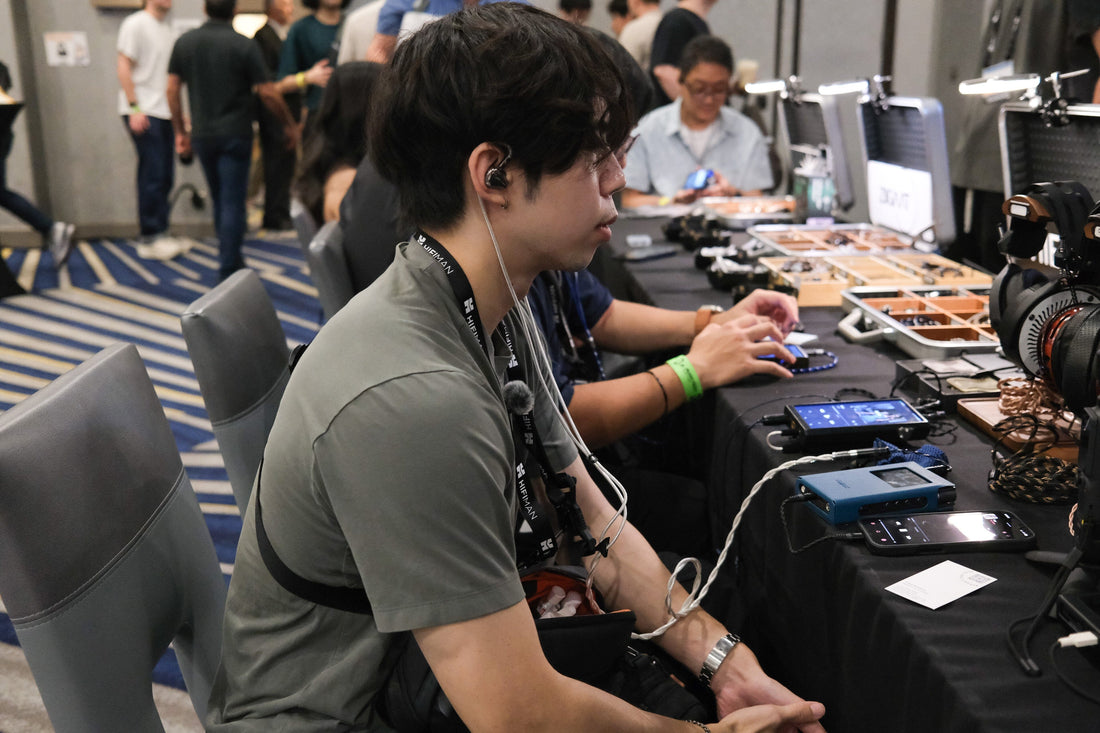
2026 marked the sixth consecutive year that I attended CanJam SoCal. Every year, it’s great meeting familiar faces and new faces alike. This year was no exception, and I spent most of the weekend catching up with people, bouncing between booths, and trying to hear as much new gear as my ears can tolerate before burning out. Even after six years, there’s still something uniquely enjoyable about having so much of the portable-audio industry packed into one place.
As a heads-up, most of the IEMs covered in this article cost upward of $1,000. That is not because there were no interesting, affordable products at the show - I heard nearly 40 IEMs altogether - but there was simply too much to fit into one article. Here, I wanted to focus primarily on the more ambitious flagships and prototypes that caught my attention.
If you’re curious about the rest, you can check out my YouTube channel for coverage of several more affordable options that didn’t make it into this article. And, as always, remember to take all those impressions with a grain of salt: I’m contending with limited listening time, the noisy show environment, and how much coffee I’ve had that morning. With that being said, let’s dive into those impressions.

64 Audio Ocean
This is 64 Audio’s latest flagship IEM. It incorporates both the classic Apex modules plus a new backvent filter system which, taken together, allows for 32 different permutations of sound. I heard it on the M20 modules plus the Reference, -2dB, and +2 dB filters.
My overall impression is that the Ocean falls mostly along the lines of the U12t in nature with improvements in the technical department. It’s slightly more detailed, it images a little more expansively, and it has superior dynamics down-low. The main tuning changes would come down to where the Ocean seems to notch for its pinna (I think it’s a little later which adds back some midrange clarity) and the IEMs’ respective treble responses. The Ocean has a little less lower-treble, similar dipping in the mid-treble, and has some more sizzle to its upper-treble. For me, the treble is fine but I feel like it could be more controlled and I think there’s some masking occurring where the upper-treble overshadows other parts of the treble.
To be clear, all of this can change quite a bit depending on which of the filters you are using. My preferred would probably be the reference or the +2dB filters, as I found the Ocean too bright with the -2dB.
Is the Ocean $4000 good? To be frank, it’s hard for me to say. I think it’s about on par with many of the best $2000 players, possibly edging them out for technicalities but not necessarily wowing me for $4000. I think the advantage of the Ocean really lies in its tinkerability and the creature comforts which are difficult to put a price on.
AEVO ATL Peak + Aevo Miro
These are two IEMs that hail from a brand that recently made their debut in China. The Peak is the first of the two IEMs I heard. I’d describe it as having a sound that is along the lines of the Vision Ears IEMs like the Phonix; however, perhaps with more of an Eastern flavor. In this sense, the bass on this IEM is fine - it’s tilted warmer and missing some sub-bass rumble. I feel like the midrange of this IEM is structured closer to China’s qdc IEMs but perhaps not as aggressive in the pinna rise, as I hear a slight smoothing to midrange attack. Finally, the highlight of this IEM would be its treble response. It’s effortlessly extended past 15kHz and in a fairly smooth, micro-peak fashion. As a result, you get great imaging albeit, to my ears, with a slightly different tactility between the treble and other parts of the frequency response.
In general, I like how the Peak sounds overall and it’s up my alley. There’s one big caveat here, though, and it’s that if I had to guess the price of the Peak, I would have guessed $1.5K. I had to do a bit of a double take when I found out the price was closer to $7K.
Comparatively, if Peak was more ethereal and musical, I found Miro to be the more grounded of these two IEMs. The Miro has more of a lower to mid treble focus which allows its bass response to shine through a bit more and produce more rumble. I’m not sure if the bass shelf on this IEM is markedly different from the Peak actually. Overall, I thought the technical performance of the Miro was a step down from the Peak from my brief listen of the two IEMs.

Brise Audio Ibuki
The Ibuki is basically a ‘cheaper’ (let’s not lose the plot, it’s still like $6.5K) version of the Fugaku. The Fugaku requires a bulky energizer pack which the Ibuki eschews. As for its sound, I would describe the Ibuki as being a darker rendition of the Fugaku. It still packs a ton of bass down low - it’s damn good bass, perhaps not as “slammy” as the Fugaku, but it resonates a bit more and it’s nearly as satisfying.
As you move into the midrange, the Ibuki is a little more colored than the Fugaku; it notches closer to 2.5kHz and generally exhibits more warmth, more thickness owing to less 3-5kHz energy. The treble of the Ibuki is also darker than the Fugaku (the Fugaku I would describe as teetering on the edge of too bright, though, so that’s not necessarily a bad thing). It has significantly less lower-to-mid-treble crunch and more emphasis on the upper-air frequencies.
Overall, the Ibuki doesn’t blow me away based on its price tag but there’s no question that it’s a great sounding IEM especially if you’re craving bass and solid end-to-end extension.
I also got to hear the 10th anniversary edition Fugaku which costs a whopping $25K. I listened to it side-by-side with the normal Fugaku. To be honest, I don’t think one really sounds better than the other and the differences are pretty subtle to me. I wasn’t quite sure what I heard that was different but maybe the treble on the 10th anniversary edition is a little brighter.

Bryce & Kimmel Lily of the Valley
These next two IEMs are the brainchild of Leneo, one of the ex-founders of Subtonic and one of the engineers behind the Subtonic Storm. This IEM is likely inspired by his work on the Symphonium Helios to some degree too, as I hear this as being a lot like a warmer Helios. The bass on it is slammy and crispy in a way that defies how typical BAs sound for bass, and it’s accompanied by slightly more mid-bass presence than on the Helios which notches strongly at 200Hz. I think Lily of the Valley’s midrange is quite similar to Helios’ with a similar 2.5kHz pinna notch and some linearity up until 5kHz. Past this point, this IEM’s treble is characterized by a slight sharpness to transients in the mid-treble to upper-treble. This is definitely a brighter IEM that teeters on the edge for me, and I think the treble might benefit from tip swapping. Overall, I mostly like how this IEM sounds but the treble gives me some pause.
Bryce & Kimmel Osmanthus
This is the more V-shaped of the two IEMs; however, I wouldn’t describe it as being a conventional V-shape - the midrange is too carefully curated for that. Yes, you also have quite a lot of bass but it’s clear that it’s been tuned to maintain technical qualities, particularly crispness and slam. There’s a sense of the bass on the Osmanthus having bass when you need it in a track and being more tame when you don’t need it.
As I alluded to above, the midrange of this IEM is also perceptually pretty close to being neutral to my ears and it doesn’t have a typical V-shape structure. Moving into the treble, the Osmanthus has something of a series of treble peaks that are relatively level in amplitude. It’s actually more controlled than Lily of Valley here in my opinion, and I found it to be more tolerable. For a sense of intangibles, the timbre of the Osmanthus is synonymous with Lily of the Valley with the crisp attack and the non-etched decay that is reminiscent of studio monitors. Overall, I liked listening to this IEM and I think it’s a strong performer if you’re looking for something that strays tastefully from neutral with bass boost.
Both the Lily of the Valley and the Osmanthus sport Grade 5 titanium shells which I think is an excellent touch; these are IEMs that feel genuinely premium in the hand.

Canpur CP104E
This is the latest flagship IEM from Canpur, and I don’t like it very much. To my ears, it’s oriented towards the more analytical side. The bass on it is sub-bass focused but there’s not a lot of quantity, lending to a drier presentation. I found the CP104E to be tilted towards the upper-midrange for clarity, and then for it to have a quite bright and somewhat splashy sounding treble response. Basically, I hear the vision here but I think it’s been taken too far in that direction and $4800 is a brutal ask to my ears. Also, this is another IEM where I feel like the acrylic shell is a step in the wrong direction, especially for what’s such an expensive IEM; this one felt particularly cheap to me.

DUNU Noctua
The DUNU Noctua is a slightly strange-sounding flagship to me. The bass is decent. I would describe it as being more U-shaped in curvature; however, somewhat lacking in texture at some moments to me. It’s not necessarily bad bass, but it also doesn’t quite strike me as flagship-caliber.
My bigger issue is the midrange. The Noctua has a good sense of scale here; vocals sound immersive and large but I suspect the pinna structure is more unorthodox. At the very least, the way they’re imaged sounds a little unnatural to me.
There’s something similar going on in the treble to me wherein it sounds fairly smooth overall, yet certain frequencies are positioned noticeably more forward in the presentation. My suspicion is that there is some dipping between these areas of emphasis, which would also explain why the Noctua’s timbre comes across as slightly plasticky despite possessing good detail.
The Noctua is clearly technical, particularly in its sense of scale and detail retrieval. But the tuning sounds somewhat esoteric, and its unconventional tonal structure prevents those strengths from fully coming together for me - at least on brief listen.

Hercules Audio Moses Legend
The original Moses is an IEM that I recognize for its spherical soundstage, large and colored presentation. The Moses Legend brings things back to earth and is a bit more grounded in its presentation overall. To my ears, relative to the original Moses, I hear it as being more grippy and sub-bass focused down-low and having more of a lower-treble focus (the original Moses is quite dipped out here). As might be expected, the Moses Legend is highly technical and I don’t really have any qualms in this department. I think you could say that the Moses Legend is possibly the better IEM on paper; however, it also loses some of the special sauce, if you will, that the original Moses possesses. Either way, the Moses Legend might be one of the first IEMs I’ve seen to use timascus for the build which was quite cool to see.

Jomo Invictus
My take is that this IEM has an identity crisis. The bass on it is quite elevated and with a lot of bleed, to the point of which it starts masking out bass texture. Moving upwards, I hear this IEM’s midrange as being confusing - it seems to notch for the pinna quite early and sound very thin at the same time, thus rendering one of the oddest vocal presentations of an IEM that I heard at the show. The treble on this IEM also has some sort of odd peak(s) in the mid-treble. Taken all together, I think this might’ve been one of my show lowlights.

NICEHCK x Mysticraft Dragonforged
I have to admit that I had high expectations going into this, as my friend Tork informed me he thought I would like it. Well, I do. The bass on this IEM sounds enormous, and it’s highly reminiscent of Lee’s new tuning style on IEMs like the Myth and the Hex. It rumbles and resonates with a liquidy character to it that’s addictive. Moving upwards, however, I would describe the Dragonforged’s midrange as being a bit more proper than the Myth/Hex; this is in the sense that it’s not slamming detail in your face. There’s a sense of delicacy to the way 3-5kHz, the presence region, has also been dialed in on this IEM. The treble response on this IEM I would say is fairly linear and in the micro-peak style that Lee has begun tuning his IEMs with.
Overall, this IEM sounds big, it’s highly technical, and I think it might hold up under higher listening volumes than the Myth/Hex. If you want a taste of the much more expensive Hex’s sound, or just wanted a warmer Hex, then this might be the ticket. My biggest reservation with this IEM wouldn’t be with the big sound but the equally big shells.

Nostalgia Audio Pendragon with Lord of Lorgres Cable
I originally thought that Lord of Lorgres was the name of the IEM itself, but it turns out it’s just the cable - a very expensive $3K one. Moving to the sound of the Pendragon itself, then, I would describe the bass on this IEM as being somewhat boomy and lacking in texture; just a bit cheap sounding overall. The midrange of this IEM is tilted toward warmth and this is complimented by a fairly smooth if rolled treble response past 15kHz. To my ears, the technical performance of the Pendragon is pretty comparable to IEMs you’d hear in the $200 range. Overall, the Pendragon sounds fine but fine doesn’t cut it for a $3.8K IEM, not to mention a $7K one all-in with the cable.

One Dot Audio Leviathan
One Dot Audio is a relatively unknown brand that hails from South Korea and that has begun expanding their international presence. The Leviathan is their flagship model to the tune of $1300. Generally, I find this to be an IEM that is definitely tuned with more of an “Eastern” flavor. The bass on this set sounds pretty decent albeit missing some texture owing to some bleed. Moving upwards, the pinna structure of the Leviathan is somewhat odd. Vocals are perceptually quite small and I have to really concentrate to pick them out. When I do, they are fairly detailed; it’s just an odd characteristic that throws me off. Finally, the treble of this IEM is probably its best part. It’s airy and well extended; it’s composed of distinct peaks however they’re fairly well-spaced and at similar amplitude. Overall, the Leviathan is decent - I don’t think it plays with established kilobuck hitters but it doesn’t sound bad.

Quill Acoustics Karma
I’ve heard a lot of buzz about this IEM, especially owing to them selling out of their initial batch almost instantly. My take: it’s decent but a bit overhyped. Fundamentally, the Karma is an L-shaped, bass-heavy listen. I would describe the bass as being reminiscent of Empire Ear’s bass; bold and bombastic whilst lacking a bit in the texturing department. Moving upwards, the Karma has a fairly standard-sounding midrange that’s tinged with warmth due to the large bass shelf and a gentle slope off of 3-5kHz. The treble is likewise fairly relaxed sounding sans a resonance past 10kHz that’s well-controlled. Overall, I would describe the sound here as smoother overall and lacking some ‘wow’ factor to my ears despite it being pretty pleasant. I also have to say - and this is something that I usually don’t care too much about - the build quality and materials of this IEM don’t really impress either.

ThieAudio Vera
I walked into this expecting it to sound like a refined ThieAudio Monarch MKII, at least based on cursory glance of the Vera’s measurements. In actual listening, my take is that this sounds closer to a supercharged ThieAudio Clairvoyance. The Clairvoyance is one of the OG twins that propelled the ThieAudio lineup into the spotlight back in 2021. I liked the Clairvoyance more than the Monarch for its more forgiving tuning; however, the Clairvoyance was a bit soupy sounding.
The Vera has a similar tuning direction - warm, forgiving - but this time it has the technical chops to back it up. The bass on the Vera is thick and satisfying while being relatively well-controlled. The Vera’s bass actually has slam to it, a characteristic that the Clairvoyance and Monarch were sorely lacking. It has a bit more of a sterile pinna notch at 3kHz relative to the Clairvoyance, and it sports a more noticeable crispness to midrange decay. This is owing to a significantly more dialed-in treble response with more energy in the 10-15kHz region. The Vera can sound slightly sizzly, perhaps even splashy in the treble but not in a way that I find fatiguing. Overall, this is a more musical style of tuning that reigns in the creative liberties before they run amok and I liked what I heard here.

ThieAudio Clairvoyance MKII
Speaking of the Clairvoyance, I heard a prototype of the Clairvoyance MKII. My take is that the Vera is more of a successor - at least in sound - than the actual Clairvoyance MKII. The prototype I heard had what I’d describe as more of a W-shaped tuning with a somewhat intense presentation. The midrange was on the leaner side and, while the lower treble was fairly smooth, I heard some sort of peak in the mid to upper-treble that led to some brittleness. Overall, I think the techs are there with this IEM - it has solid detail and imaging performance - the tuning just needs some tweaks before being released.
Something that I couldn’t help but notice is that this IEM is using what appeared to be titanium for its shells, likely inspired by the ThieAudio Valhalla. If this makes it to production, I will be very happy. Do be aware that this is a slightly larger IEM too, though.
 YU9 Flagship Prototypes
YU9 had two flagship prototypes at the Mysticraft table. The first version I would say was unremarkable - to me, it basically just sounded like a warmer Que. Yes, it sounded good but I didn’t find it to be great and it certainly didn’t invoke flagship-IEM vibes.
The second prototype I heard was leaps and bounds better. Overall, I would say this prototype is inspired by the Que’s flavor of tuning as well, but building off it in a more U-shaped tuning direction. It has significantly more sub-bass and shelves earlier than the Que, lending to more rumble and density down low. You no longer get any of that slightly soft/brushed characteristic to bass attack. Moving upwards, I don’t think the midrange structure has changed significantly. However, the level of detail and the timbre on this really grabbed my attention. There’s almost a liquid-esque quality to the way female vocals are presented; it’s not entirely natural, but you can’t help but nod along. Moving upwards further, this prototype keeps the general character of the Que’s treble but the granularity of its micro-peaks is even denser, more honed-in. In general, I have no complaints about the technical characteristics of this IEM; it’s excellent. In fact, this prototype was the highlight of the show for me and I eagerly await its release.
Bear in mind that this last one was definitely a prototype - the shell internals were completely exposed. Talking with the founder of YU9, he told me that he plans to spend more time refining the tuning (even though I think it’s already excellent) and that the prototype is larger than the production version will be, as the exposed shell is mostly being used for easier testing.

Wrap-Up
I’m probably one of the most jaded IEM reviewers out there, but I have to admit that there was some stuff that grabbed my attention at this show. The Dragonforged and YU9 flagship prototype were the obvious standouts, while I also listened to a very affordable IEM that genuinely impressed me which I plan to cover later.
Of course, show-floor impressions only tell you so much, and I would need more time in a controlled environment with some of these IEMs before making any definitive calls. Still, this was one of the rare shows where I walked away genuinely wanting to hear several products again - and that is probably the highest compliment I can give.

