Yu9 Que Review: Coloured Clarity
There's been a lot of talk about the Yu9 Que. Is it truly ChiFi's latest hidden gem? Fc-Construct demystifies the hype and breaks down the sound of the Que.

Introduction
Hidden gems. Giant killers. Modern day treasure hunting exists in many a hobby. Audio is no different. We’ve seen hype trains come and go. And now, we have the Yu9 Que.
At $400, it’s not outrageously expensive for this hobby. But unlike the countless Chinese IEMs that get sold through retailers like Shenzhen Audio and Linsoul, Yu9 is a brand established by a Chinese DIYer turned industry member. That means little to no Western marketing support (which these retailers play a heavy hand in) and limited distribution channels.
Yet even if you learned of the Que (I pronounce it CHU-EH) and wanted to buy one, there’s a good likelihood that it’s out of stock. Apparently, the manufacturing of it is rather complex, and the transition from a small volume DIYer to a proper manufacturer with an in-demand product is no small task.
As such, there’s been a bit of mystique around this IEM. Not many people have heard it, and the few who have have raved about it. Between fragmented hearsay from online communities to impressions lost in translation, it’s not exactly clear what this IEM is about. So today, let’s run through what you get with the Yu9 Que.
Source(s) Used: Ferrum ERCO, Apple USB-C dongle, FiiO Q7
Disclaimer: Review unit was provided by Yu9.
What we like
- Proper W-shaped tuning with an almost creamy midrange
- Unique sense of imaging, layering, and instrument separation
- Little pressure build-up in-ear
What we don’t like
- Fit and comfort is awkward
- Eartips can change sound quite a bit
- May be track and recording dependent
- Treble skews upwards for those sensitive

What in the Box?
There’s nothing too fancy with the unboxing experience here. You get:
- A large cube-shaped carrying case. Nicely padded on the inside with plenty of room.
- Two sets of tips. One is the typical AET07 clone tips in S/M/L. The other is a set of S/MS/M/L Xelastec-like sticky silicone tips that come in a small case.
- A basic microfiber cloth and cable clip.
- A black 2-pin cable. This cable is a little different from the typical ones you get from Chinese IEMs. The sheathing is a bit of a stiffer plastic while the 2-pin connector has an extended protrusion. I would swap out the cable for better ergonomics but the stock cable is serviceable.
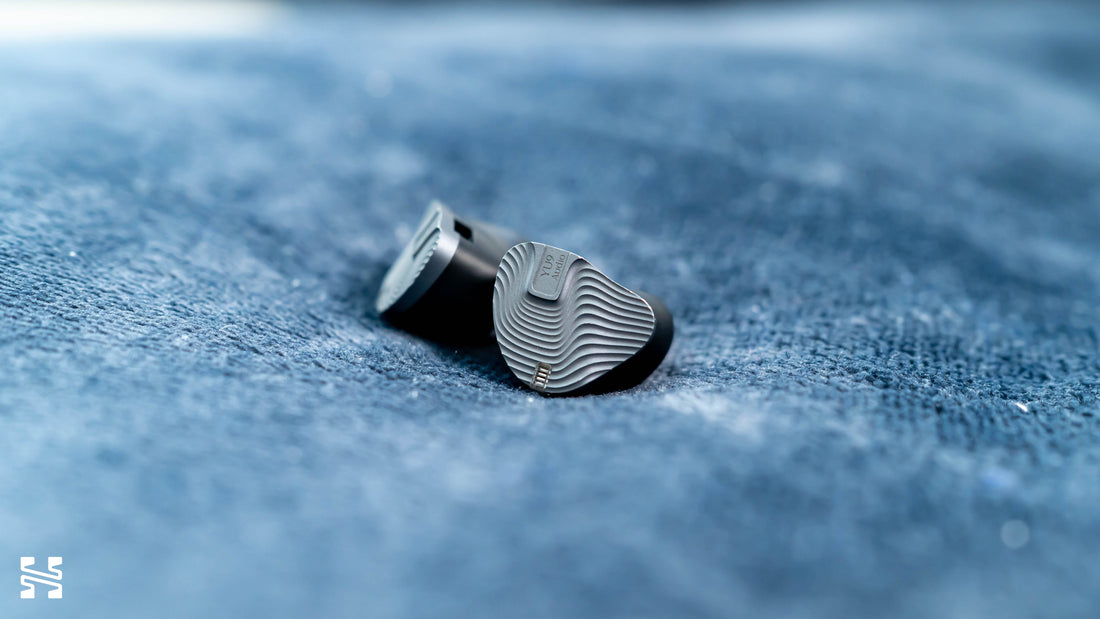
- The Yu9 Que itself. It’s a 1 DD + 3 BA IEM. The shells are 3D printed from a high quality resin with a slightly matte touch. The faceplate is a metal piece with an intricate wave-like pattern. There is a single vent at the top of the shell. The nozzle has an interesting 4 bore design with a crescent shaped opening. Note that the 2-pin socket is more recessed than usual.
While it may look and feel like a regular IEM, there are enough diverging details about it that make it clear the Que is a ground-up design. According to Yu9’s founder, it takes about 3 - 4x longer to produce the Que than it does similar products. I can’t confirm or verify that, but I wouldn’t be surprised.

Fit and comfort wise, I do have some reservations. The initial fit isn’t a problem. The nozzle diameter is somewhat large at 5.8 mm, but many IEMs are over 6 mm these days. The nozzle length is about 4 mm. It’s short enough that the shell of the Que presses up a little against my ears. Not painfully so, but not in a way that I forget about. The shell isn’t super chunky either, at least compared to modern IEMs. Interestingly, I don’t get a “pressure build-up” feeling to it upon insertion. It’s as if it’s much more vented than it may appear, almost to the level of an open-back.
The problem is more that it never seems to get fully comfortable. They fit fine at the start, but they don’t seem to “break-in”. I’m not sure why. There’s nothing about its ergonomic design that sticks out as problematic. Even tip rolling doesn’t seem to help much. At any rate, I give it an OK at most for fit. Not a deal breaker, but it’s not comfortable in the way that it disappears in my ear.
Sound - Objective
Here’s the frequency response graph of the Yu9 Que calibrated to the population average DF HRTF. As a reminder, the preference bounds are depicted in the grey region. In extremely simplified terms, if the frequency response is within the bounds, it’s likely to sound balanced. And that means it’s most likely to be preferred by the average person - hence the name, preference bounds. That said, 1) You are not an average person; and 2) There’s no reason why you can’t enjoy multiple types of tunings. It’s a question of probability.
In less simplified terms, the Que is a W-shaped IEM. You can see it in the graph where the bass shelf flirts with the edge of the bounds, the mids has an obvious hump at around 1 - 2 kHz, and an upper treble elevation that steps above the “balanced” threshold. It is a broadband elevation instead of a peaky one though.
Here is the raw graph which is a different visualization of the same dataset.
Here we can get a different perspective of what that midrange and treble is doing. Instead of a forced hump in the mids, it’s more of an early pinna rise and a relaxed 3 kHz. Likewise, the treble isn’t going for excessive amounts of air. Rather, it’s more that it carries the mid-treble brilliance a little further instead of rolling-off.
Interestingly, the Que is very tip sensitive. Here it is using the stock AET07’s vs. the Divinus Velvets. Practically no change (on the graph).
But here it is with the Final Audio Type E and the AZLA ASMR Max tips. Notice how much the treble changes compared to the AET07.
As usual, it should be noted that treble measurements tend to be rather inaccurate. But it is interesting to see these differences. Especially given that in my experience, the AET07 and ASMR Max tips tend to be very similar, while the Divinus Velvets and Final Type E significantly tame the treble. However, that’s not the case here.
Sound - Subjective
Bass
I have one complaint with the Que’s bass. For such a sizable bass shelf, it doesn’t dig too deeply into the subbass. This is primarily true with the kick drum, where very lowest octaves seem to roll off. This makes the Que feel like it could use even more bass at times. It’s like that last little bit of oomph is just out of grasp.
Yet, it really doesn’t. The Que frequently catches me by surprise with how big and dynamic its midbass presence can be. Specifically, around the 50 - 100 Hz region. For sustained bass notes like that of a bass guitar or synths, there’s a richness that fills the room. Drum notes like the toms border on boomy, but stops shy of being bombastic. Instead, it’s more of a foundational bassiness where notes build from the ground up. This gives the Que a firmness in its bass lines that avoids feeling pillowy. And while I wouldn’t call it a punchy sort of bass, notes are still well defined and textured with a roundedness in its transients.

Mids
The Que’s midrange is one that’s familiar to those who’ve been in the hobby for a while. We’ve seen variations of this sort of upper mids structure before. Ironically, with more and more IEMs being tuned towards the “new meta” midrange, this sort of tuning with an early rise and plateauing 3 kHz has become rare. That’s not without reason though - the “new meta” midrange does often sound more clear and natural. In contrast, the older style can sound coloured and timbrally awkward depending on the implementation.
The Que does a good job of avoiding some of the pitfalls that are common to this sort of tuning. It generally avoids the sense of congestion that occurs with the 1 - 2 kHz hump and 3 kHz recession. Vocals are given density in their timbre without sounding overly nasally or shouty. Part of this is due to the transition from the bass to the lower mids where some of that lingering low-end energy adds warmth. At the risk of sounding too flowery, there’s almost a sense of creaminess that’s added.

That said, this is where the Que shows some of its compromises. While a recessed 3 kHz might be nice for those who want a thicker sound, you do lose some of the upper harmonic clarity that allows notes to cut through the mix. Poorly mastered tracks, particularly chuggy rock tracks, can become blurred here, losing the bite that defines more energetic, aggressive notes.
Instrument wise, pianos and strings do very well on the Que. Its richness lends a grander sense of scale to these voice-like instruments. However, the sharp, punctuating crack of the snare drum can be dulled and thus tracks lose some of its snappiness. Altogether, the Que’s midrange is built for an indulgent sound.

Treble
While the Que has an undeniably brighter treble, it’s more of an added vibrancy to the crispness to the hats and cymbals rather than a sustained shimmer or airiness. Importantly, I don’t hear any major peaks with the Que. It’s surprisingly smooth all the way through the upper treble without losing feeling like it’s been overdampened or exaggerated. Even on the stock AET07 tips which should have the most treble, I didn’t find sibilance or harshness or peakiness to be an issue. I suspect the odd crescent shaped nozzle bore is playing a role in controlling treble response here.
This treble extension is the Que’s secret weapon. It plays a critical role in bringing the necessary clarity to balance out the bass shelf and relaxed 3 kHz pinna. Higher order harmonics get a lift for a bit of definition and bite to allow them to pop. That said, I can see where some who are sensitive to treble might complain. There were a couple instances where I found the hats and cymbals came in a little too hot when introduced into a track.

Presentation
The musical presentation of the Que is its standout feature. There’s a unique sense of spacing on top of a very clean background. It’s as if every instrument has their own little pocket to play in around the vocals that take a clear center stage. This creates a nice layering effect where individual passages from each instrument are highlighted while background details are picked up as accents to the main melodies.
It’s not that the soundstage is extremely wide or the imaging extremely precise. Rather, the staging feels comfortable in its expansiveness and the placement of instruments gives a cohesive image of the soundscape. It’s also not that it’s super resolving and pushes lead notes to the forefront. Rather, it’s the little nuances and subtle effects that are brought into focus on that clean background.

To be clear, everything I just described are “perceived” technicalities - they are a product of the frequency response at the eardrum. But my pet theory is that part of our perception of technical performance comes from listening to music from a different perspective, when your brain is forced to re-examine notes when presented with a sufficiently novel tonal viewpoint. That’s what the Que does. It’s not neutral. It’s coloured clarity. One that I’ve rarely heard presented in another IEM.

Should You Buy It?
Yes, but. While I’ve spoken highly of the Que in this review, I also want to temper expectations. At the end of the day, this is an IEM. A relatively normal one that falls largely within the preference bounds. The mysticism of “hidden gems” and “giant killers” often leads to disappointment when exaggerations meet reality. Past your first couple of headphones and IEMs, that wow factor is hard to come by.
Anecdotally, my opinion of the Que has come full circle over the past couple months. This coloured clarity I speak of is how I first heard the Que. Then, there was a moment between listening sessions where I became fixated on the timbre of a relaxed 3 kHz and early pinna rise. While it leads to a unique musical presentation that accentuates good mixes, it can further bog down bad ones.
However, as I sat down to finally write this article with the Que in my ears, most of my concerns with its recording dependency went away. Perhaps it’s brain burn-in, but as I work across my library trying to find a song where the Que fails, I feel like I’m grasping at straws to find something to complain about.
With all that said, whether you hear the Que’s tonal compromises or its coloured clarity like I do, the Que is certainly not just more of the same. Few IEMs have challenged me to think about sound and how to describe it quite like the Que has. There’s a purposeful creator’s vision here instead of boutique esoterica.
What gives me the confidence to recommend it is the $400 price tag. That’s not cheap, but it’s not wildly expensive either. The current IEM market is filled with countless IEMs around that price rehashing tired ideas. Many of them you can safely skip. Even if you might not love the Que, it’s one that’s definitely worth trying.

