Subtonic Storm vs. Mysticraft Hex - What's the best IEM in the world?
Subtonic Storm vs. Mysticraft Hex: Which luxury in-ear monitor reigns supreme in audiophile's summit-fi price bracket?

Introduction
One of the questions I get asked most often is: “What’s the best IEM you’ve ever heard?” Normally, I’d just point people to my ranking list and call it a day. But every once in a while, a comparison comes along that deserves more than a number on a spreadsheet. The Subtonic Storm and Mysticraft Hex are exactly that type of comparison. These are two extremely expensive IEMs that present two very different answers to the same question: what should a no-compromise IEM actually sound like?
The Subtonic Storm, at $7,300 USD, needs no introduction in the upper echelons of the audio world. But for the uninitiated, this is the halo product from Subtonic, a small boutique manufacturer out of Singapore. Since its release in 2023, the Storm has stood at the top of the IEM world for many listeners, myself included. This IEM, with its 7BA/2EST setup, redefined what I believed possible from both the balanced armature and electrostatic driver topology.
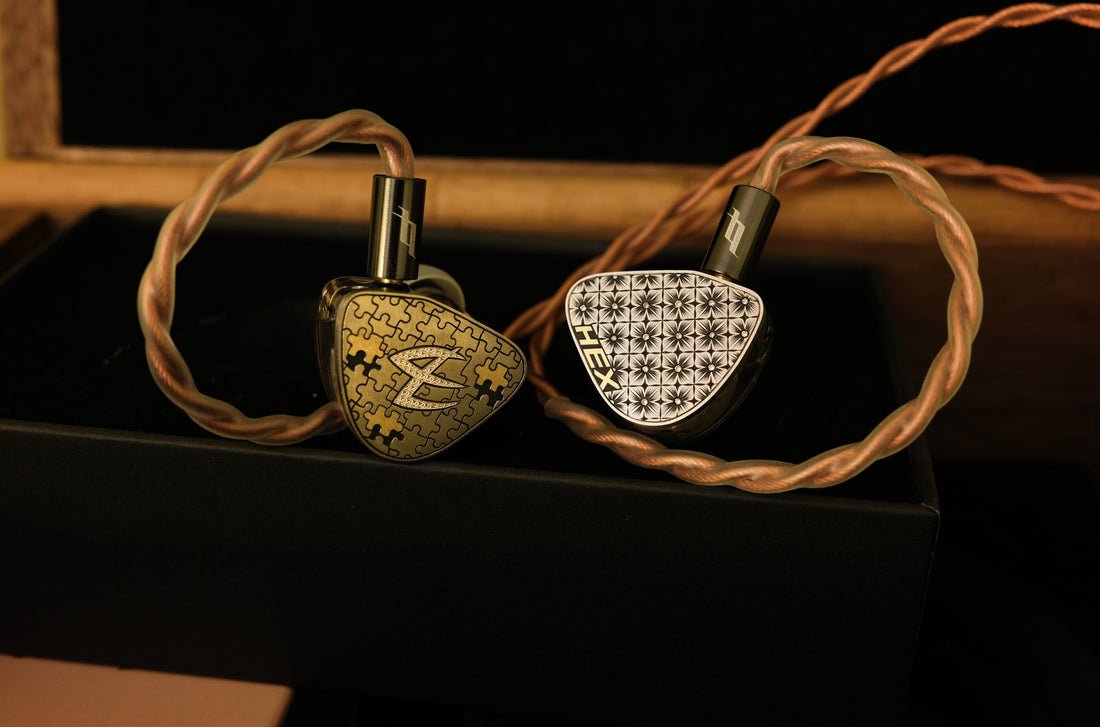
The Mysticraft Hex might require more context. Mysticraft is a brand founded by Lee Quan Min of Elysian Acoustic Labs fame; the Hex is the brand’s $9,800 USD flagship IEM. Like the name implies, the Hex is not a simple design: it uses six distinct driver types, thirteen drivers total, and ties everything together through a staggering 10-way crossover. On paper, it reads like the type of IEM that should either be an engineering flex or a trainwreck. In practice, it’s very clearly the former.
And that’s what makes this comparison interesting. The Storm and Hex are both technical monsters, at the bleeding edge of the IEM world, but they arrive there by treading distinct paths. In this comparison, I’ll be taking a walk down each of these paths and helping you decide which one is for you - if your pockets are fortunate to run this deep.
The Mysticraft Hex was loaned for review by ‘Rolu’. The Subtonic Storm was loaned for review by ‘Valoncia’. Listening was done off of an Apple USB-C dongle, TruthEars Shio dongle, and Lotoo Mjolnir. I used AET07 silicone tips with both IEMs. As always, what follows are my honest thoughts and opinions to the best of my ability.
The Tangibles
From a high-level down, the Hex is what I would describe as ostentatious: diamond-studded shells, more driver types crammed into it than I care to name, and a clear resin build designed to show-off the impressive internals. I generally don’t associate the Storm’s design with restraint, but I do in this comparison. Its sturdy Grade-5 titanium shells conceal its hybrid driver configuration and its gold-enameled faceplates have a more utilitarian character to them (despite being pretty flashy in the grand scheme of things).

In terms of fit and comfort, the Hex is noticeably more elongated at the nozzle and it’s a bit thicker than the Storm. I wouldn’t say it’s uncomfortable, but it definitely sticks out more visibly from my ears. The Storm is also a large IEM - and it’s heavier than the Hex - but the nozzle sits more flush and I have better luck with getting it to appear ‘normal’ in my ear. Neither IEM is for listeners with smaller ears.

For drivability, the Hex is one of the most sensitive IEM’s that I’ve handled - to the point of which it picks up faint crackles/static depending on the electronics that I’m physically touching. For example, if I’m touching my phone screen and there’s no music playing, I will hear static flowing through. It’s not a big deal, especially once I start listening, but it’s worth noting. It takes very little power to drive; I sit at around about 5% volume on the Apple USB-C dongle. On the other hand, the Storm is almost notorious for being insensitive. It requires a lot of power for an IEM to get it to normal listening volumes.
Sound Analysis
Tonally, there’s a major difference in philosophy between these two IEMs. Consistent with its flamboyant build, the Hex’s sound is oriented around announcing itself as something exotic - the type of presentation you imagine when someone says, “This IEM costs $5,000.” It wants to sound grand and vivid; it’s not remotely concerned with sounding accurate.
The Storm is coming from a very different place. Its tuning is based more around the Genelec studio monitors: neutral, controlled, and reference-oriented. While it has enough deviation from a true reference monitor to have character - more on this later - it’s not trying to put on a firework show in your ears. It sounds expensive in a quieter, more refined way.
If there’s one area where Lee has clearly ascended from his Elysian days, it’s bass tuning: the Hex's bass is no afterthought like on the Annihilator. The Hex’s bass is bold, bouncy, and extremely large-sounding. It almost envelops you, and it’s a major part of why the Hex sounds so grand. To be clear, while the Hex's bass is tilted more toward fun and putting on a show, there's a tinge of dryness and enough control to keep it from losing the plot.
Comparatively, the Storm's bass has slightly less sub-bass and considerably less mid-bass. It’s more mechanical and about holding down business. It sacrifices some of the Hex's addictive debauchery for a little more attack distinction on the opening synth bass of Girls Generation’s “Paper Planes”. As far as I’m concerned, there’s no right or wrong here, and what matters more is my mood.

Midrange-wise, one of the defining traits of the Hex is its aggressive, early 1.5kHz pinna rise followed by a flat 2–4kHz region. It’s a double-edged sword: on one hand, it gives vocals an unparalleled sense of raw clarity and attack sharpness; on the other, it can sound slightly “off” at first and require some acclimation. For me, it’s not as glaringly obvious as when Lee pioneered this flavor of tuning with the Elysian Gaea, but the forwardness can get stale over extended listening and louder listening volumes.
The Storm, by comparison, comes across warmer and more bodied. It has an ever-so-slightly reserved pinna notch at 3kHz that promotes higher listening volumes. And rather than pushing clarity directly to the forefront like the Hex, the Storm extracts detail more subtly through micro-peaks at 4kHz and 5.5kHz respectively. The result is a midrange that feels less ‘clear’ than the Hex initially, but that is appreciably more believable and holds up better at louder volumes.

These are advc's measurements of different Subtonic Storm/Mysticraft Hex units taken on a clone IEC 60318-4 coupler, because Precogvision does not have a measurement of the Mysticraft Hex currently available.
One of the Storm’s only real weaknesses, to my ears, is its extension past 16kHz. It’s not exactly rolled-off, but there is a noticeable sag in energy. Don’t get me wrong - the Storm’s treble is still excellent, but if it’s trying to emulate a studio monitor, this is one area where it doesn’t quite line up with how I hear monitors. In any event, the result is a treble response that sounds weighty, dense, and rigid if lacking that last leg of airiness. I also feel like it can occasionally have a slight emphasis at around 10kHz, where it’s like cymbals have been struck with extra intensity. But my perception of this changes a lot depending on source pairing.
The Hex, comparatively, stretches a little further upward into the upper-treble than the Storm and has a more scooped 5–6kHz region. This gives its treble a more fleeting, stylized, and atmospheric quality all while remaining decently grounded. With the right eartips and source, its treble sounds well-controlled and extremely detailed - more or less par with the Storm. The important thing to understand is that the Hex is not going for accuracy at all, although these IEMs are colored in their own ways in the treble.

Technical Performance
The most notable difference between these IEMs, in terms of intangibles, is how they present detail. The Hex isn’t shy about it. It basically spams you with detail through its aggressive 1-3kHz pinna rise and more elevated upper-treble response, giving transients a conventionally sharp, crisp, and hyper-delineated edge. The Storm can’t hold a candle in this regard. And the Hex is charismatic, fairly convincing in the way it does this even if it can feel like it’s trying a little too hard to impress you at times. To give a rough benchmark, I would say it’s absolutely more detailed to me than the Elysian Annihilator 2023 which I own for comparison.
The Storm approaches detail more tactfully. Its note attack is still crisp, but less scalpel-esque. It feels more revealing of small, incidental sounds: the tiny inflections that come after a note hits or a singer croons, a shaker tucked in the back of the mix, or an instrument you suddenly realize has been there the entire time. On Nmixx’s “Know About Me”, I suddenly notice the slight waver, fuzziness of the opening synth before it snaps back to clarity; on Tenille Art’s “Somebody Like That” I realize there’s faint foot tapping in the backdrop to add atmosphere. In practice, the Storm’s made me go, “Wait, I’ve never noticed that before” more than any other IEM I’ve heard, even on songs I’ve heard hundreds of times.
Basically, the Storm is just as detailed as the Hex, but the Storm doesn’t shove detail at you. It guides you toward it, and it’s through a combination of high micro-contrast and very low auditory masking. The Storm’s two steps ahead of the Annihilator 2023, a step ahead of the Hex in this department - it’s unequivocally the most detailed IEM I’ve heard to date.

For staging, I’m of two minds. The Hex is what most people probably imagine when they hear “technicality monster.” Its stage is consistently open, expansive, and holographic. It gives you that instant wow-factor, like walking into a massive auditorium with the lights and sound floating around you; the scale cranked all the way up.
The Storm doesn’t stage as obviously wide or open as the Hex. But the longer you listen, the more you realize it’s a little more precise about where everything is placed. It’s less about sheer stage size and more about layering; the way instruments occupy their own space and interact with other sounds. The Hex gives you the grander room; the Storm gives you the better sense of where everyone is standing inside it. For my tastes, I prefer the Hex here, but I want to temper expectations by saying that everything I’m describing here is for an IEM.
Dynamics are top-tier on both IEMs. However, the Hex’s macro-dynamics are more immediately apparent: big swings in volume hit harder and the whole presentation has a lively quality irrespective of source or volume. I feel like I have to crank the volume more on the Storm to begin replicating the same sensation. The Storm, then, is more micro-dynamic focused. It feels like there’s finer gradations in volume across the bass, midrange, and treble.
This is somewhat interesting to me given that the Hex utilizes piezo and bone-conduction drivers, but one might say it’s a testament to the importance of the resulting frequency response and implementation. The Hex’s graph has more delta and contrast looking at the big picture. But zooming in, the Storm’s frequency response has more nuance, and it facilitates higher listening volumes (for better or worse).
Source Memes
Scalability, the idea that a transducer meaningfully benefits from more powerful or more exotic sources, is a charged topic in the audio world. So to be clear: I’m not coming at this from the perspective that everything is mystical, or that every tiny change in the chain radically transforms what you’re hearing. My general stance is that the overwhelming majority of what we hear - let’s say 90% or more - is explainable through frequency response.
That said, there seems to be a smaller component of the listening experience that either comes down to things we don’t currently measure well, don’t know how to interpret properly, or simply aren’t looking for in the first place. And the Storm has been one of the IEMs instrumental in convincing me of this.
In essence, the character of the Storm changes noticeably depending on the source I’m using. It’s not that it suddenly becomes a different IEM, but its dynamics, resolution, and timbre seem to shift more than I’m used to hearing from most IEMs. To get even more nebulous, I also feel like the Storm is unusually sensitive to cables. I need to emphasize: this is a tiny difference, as in I get a lingering sense of something sounding slightly different between cables.
And I think this is one of the core distinctions between the Storm and the Hex. The Hex benefits from nicer sources (as I’ve found most IEMs do if only subtly), but I don’t think its ceiling is quite as high. Its baseline for sounding good is also much lower. You can plug the Hex into an Apple dongle and still get a concrete picture of what makes it sound so special - and I love that about it.

The Storm is different. Off a weaker or more basic source like the Apple USB-C dongle, it can sound good, but I find the treble becomes harsher and takes on a digital sheen to its timbre (despite my usually associating the Apple USB-C dongle with being more dulled). It doesn’t fully come ‘alive’ in the same way. So if the Hex is the more plug-and-play technical monster, the Storm is the one that feels more scalable - more demanding, more temperamental, but also potentially more rewarding with the right synergy.
Running Storm through a couple sources, the difference between the Lotoo Mjolnir ($7000) and the Truthear Shio ($70) mostly comes down to their technicalities - on the Mjolnir, the Storm has superior dynamics, a grander sense of scale, and a more uncolored tonality. But I don’t entirely prefer it versus the Shio, as the Shio actually has tighter bass and more midrange texture for me. I’ve also heard the Storm off other sources (e.g. the iBasso 320 Max, Hiby R6 Pro II, Hiby RS8) at audio shows that I think it pairs substantially better with.
Likewise, I genuinely prefer listening to the Hex off of the Apple USB-C dongle versus the Mjolnir or the Shio because the Apple dongle is more dulled, forgiving in the highs. It controls the Hex’s micro-peaks better. The Hex gets too bright and sharp for me with the latter sources despite them having superior technicalities.
So I want to emphasize that synergy, not necessarily price, is the key here although my experience is that there is a loose, positive correlation between price and ‘better’ sources if you’re solely chasing technical qualities.

The Bottom Line
Normally, I wouldn’t digress into the analogies much. But I will because these IEMs are luxury purchases. Luxury purchases are predicated on the experience, the feeling, and what you value. One of the most common luxury purchases that comes to mind is the automobile. The way I feel it, then, the Storm versus the Hex is a bit like choosing between a modern, manual Porsche and a PDK (automatic transmission) Porsche.
The modern, 6-speed Porsche is exceptional because it blends the convenience and polish of modern engineering with the feeling that you’re still involved. The car is helping you, smoothing things out, but you’re still exercising an extra layer of decision making by rowing the gears. There’s a higher, deeper connection between input and reward. That’s the Storm. It’s refined and technically excellent, while still asking you to engage with it. You feel like you’re learning about your music as much as you’re enjoying it.
The Hex, by comparison, is more like Porsche’s PDK which is often described as being nearly telepathic. You don’t have to think about the mechanics of what’s happening; it just does the thing, and it does it incredibly well. It’s faster, easier, there's zero learning curve, and it’s maybe even more “perfect” in a vacuum. You hit play on your iPhone with the Hex and your music comes to life, served highly colored and exciting on a silver platter. But depending on what you value, that effortlessness can either feel like magic or like you’re missing something.
For me, the answer is clear. I’m someone who values that extra layer of engagement, and the Storm’s ethos resonates with me more even if I dislike that it requires source matching. The Storm is the IEM that I’ve considered purchasing multiple times, dumping my annual retirement contribution into instead, and the only IEM that I think is worth more than $5K. I don’t have any such feelings for the Hex, as much as I enjoy the ride.
However, I’ll end on this note: You probably don’t care much about price if you’re considering either of these IEMs. And I think which one you prefer says less about which is objectively better, and more about whether you want to feel like you’re driving the experience or letting the experience drive you.

