Catching Up with DUNU - DN142 vs DN242 Dual Review
Let's check in with an old friend of the IEM space - DUNU - and see what their new DN142 and DN242 models have to offer.

Introduction
It goes without saying that the IEM community is the biggest it’s ever been. Countless new Chinese brands have cropped up over the years, some capitalizing on one or two hit models while others fade into obscurity. Amidst that wave of new entrants, DUNU remains as part of the old guard trying to compete in a rapidly changing market. And to their credit, they’ve seen recent success with the much praised DUNU x Gizaudio DaVinci.
This time, DUNU has released a pair of new IEMs: the DUNU DN142 and DN242. The DN142 runs $250 while the DN242 comes in at $350. Naturally, it’s tempting to see them as siblings, with one being an “upgraded” version of the other. But in a hobby like this, assumptions don’t often amount to much and neither does marketing. So let’s take a closer look at what these IEMs offer.

What’s in the Box?
Both products come with DUNU’s standard sets of accessories. These are:
- 3 sets of tips in various sizes - DUNU S&S, Candy, and regular silicone
- The classic DUNU 2-pin cable with interchangeable terminations
- A carrying case, 6.35 mm adapter, and cleaning brush
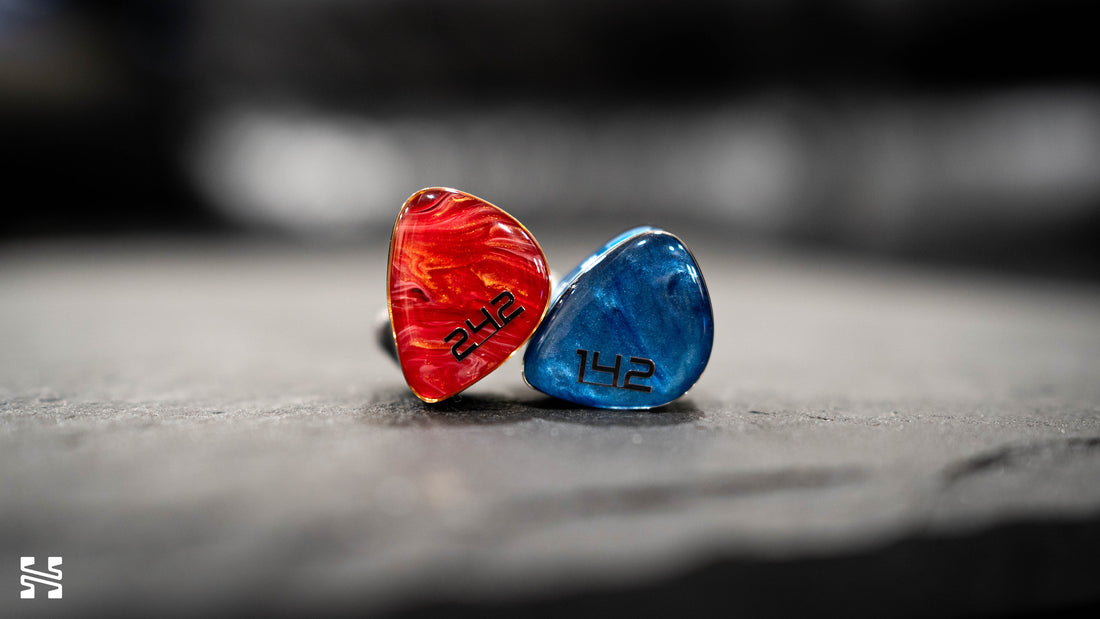
The difference, as you can see in the pictures, are in the shells. The DN142 is “watery blue” while the DN242 is “fiery red”. These designs are inspired from Chinese mythology, specifically characters from the classic 16th century novel Investiture of the Gods, and the box art shows DUNU’s interpretation. It’s been a recent trend among Chinese brands to lean into their cultural roots for aesthetic designs.
What’s interesting however is that the shells aren’t the same with just a color change. They do fit and feel different. Even the nozzles are different designs. Personally, I found the DN242 to fit quite a bit better than the DN142. While both shells are about the same bulkiness to them (that is to say, quite bulky), the DN242’s nozzle is angled better for a deeper and more secure fit while the DN142 sits a bit more on the outside of my ear. This is despite the fact that the DN142 has a 6.1 mm nozzle diameter while the DN242 has it at 6.4 mm. While I could wear both for a good amount of time, I definitely would prefer to wear the DN242.
For those interested, here is the driver configuration of these IEMs:
- DN142: 1 Dynamic Driver + 4 Balanced Armatures + 2 Planar Drivers
- DN242: 2 Dynamic Drivers + 4 Balanced Armature Drivers + 2 Planar Drivers

Sound
Here are the frequency response measurements of the DN142 and DN242 calibrated to the population average DF HRTF, measured on my clone IEC-711 coupler. Take these measurements with a grain of salt. Preference bounds are depicted in the grey region. In extremely simplified terms, if the frequency response is within the bounds, it’s likely to sound balanced. And that means it’s most likely to be preferred by the average person - hence the name, preference bounds. That said, 1) You are not an average person; and 2) There’s no reason why you can’t enjoy multiple types of tunings. It’s a question of probability.


DUNU DN142

Bass
First, let’s talk about the DN142. You can see that it’s a U-shaped IEM with a slightly forward tilted midrange. Upon listening however, the DN142 isn’t quite as bassy as the graph implies. Most of that energy is really in the subbass - and paired with the forward upper mids and significant treble elevation, much of the midbass presence is hidden. So unless notes are especially rich in the subbass, I didn’t feel all of that bass elevation strongly as you might expect.
And crucially, the DN142’s bass wasn’t particularly impactful for me. Weighty, yes, when there’s sufficient subbass in the recording. But the sense of impact and dynamism wasn’t quite there for me. It’s more of a quantity-first approach.

Mids
Ostensibly, I should like the midrange and lower treble of the DN142. It sticks within the preference bounds while being forward tilted for vocal presence. In practice, it’s alright. It can come off almost lean because of that upper treble exaggeration boosting some of the upper harmonics.
The upper mids suffer a bit from what I call the “ear gain-y” effect where vocals and similar midrange focused instruments feel a little isolated due to the strong upper mids presence at the pinna peak. It doesn’t sound bad, but there is a touch of sterility or notes being stretched, for lack of a better description.
Treble
Like the bass, while the upper treble seems painfully excessive in my measurements, it lends more of a sense of exaggerated wispiness and shimmer to my ears rather than being big, harsh peaks. For example, instead of hard, piercing sibilance in the vocals, I hear more of an extended ‘Ssss’ after the initial transient.
Hats and cymbals have a similar effect where the note decay has more of a wispy element instead of a strongly crisp, sharp attack. While boosted treble may sometimes be perceived as “increased resolution”, in this case I don’t think it helps much. Notes can run into each other and become confused because of the imbalance in how they’re rendered.

Presentation
In terms of perceived technical performance, the DN142 is like most IEMs. Decent stage width and horizontal imaging. Little to no height or depth. Resolution and layering is surface level. Don’t take this as complaints - take it more as a general comment that the DN142 doesn’t provide more than what your average IEM delivers.
Conclusion
Overall, I think the DN142 is an okay IEM. I don’t dislike it. Despite my nitpicks, they aren’t deal breakers for me. The treble can be a bit much at times, but that’s about it. However, my biggest problem with the DN142 is that it simply did not elevate my listening experience. $250 isn’t wholly unreasonable, but falls short in a highly competitive market. Approved, but not recommended.

DUNU DN242
Next, we have the DN242. It arguably sits more within the preference bounds, though there is more 1 - 2 kHz forwardness in the upper mids while the rest of the midrange tuning is a bit more of a roller coaster. Clearly, it’s not just the DN142 but slightly modified. It is a whole new IEM with a distinct tuning philosophy of its own.
I’ll be upfront. I found the DN242 more enjoyable than the DN142. And no, it’s not because it’s $100 more expensive. When I was first testing these IEMs, I forgot which was which and picked one randomly to listen to first. That happened to be the DN142, which as described above, was OK with some disclaimers. But switching to the DN242 felt immediately more comfortable and enjoyable. Not a night-and-day difference, but enough that I would definitely take the DN242 over the DN142.

Bass
In the bass, the key difference between the DN242 and DN142 is how the shelf is shaped. Obviously, there’s less sheer quantity. But there’s also more midbass presence around that 150 - 200 Hz region as it transitions into the lower mids. So despite having less subbass energy, it is still properly bassy. The balance here gives DN242 a better sense of impact and depth than what the DN142 offered from pure quantity.

Mids
In the mids, we see a 1 - 2 kHz hump followed by a relaxed 2 - 3 kHz. Normally, this is where I get a little wary as the 1 - 2 kHz elevation can lead to nasally, congested sort of sound. But on the DN242, I don’t find this to be an issue at all.
The raw graphs demonstrate this well I think - it’s less of a roller coaster in the mids and more of a soft relaxation at 3 kHz. There’s still energy at 4 - 5 kHz to give clarity in this region. While the lack of a 3 kHz peak might make vocals seem recessed, that’s not the case either. I find vocals to be appropriately highlighted with just enough presence that it’s not lost in the mix. Importantly, the midrange feels a lot more cohesive and “glued together” compared to the DN142 where instruments can come off as isolated.
Treble
Like the DN142, the DN242 shows some big treble peaks. And like the DN142, I don’t find these treble peaks to be hard or painfully peaky. The DN242’s massive upper treble peak is past 15 kHz where there’s little musical information - it comes off as an extra little touch of air, if anything. The more important peaks are located around the mid-treble. Here, they lend a bright tinge to the music with a crispness to the hats and cymbals that isn’t overdone. Unlike the DN142, it doesn’t overextend the shimmer and decay. As such, the DN242’s treble is cleaner to me. It’s not totally clear and there is some tizziness to the treble, but these are minor complaints.

Presentation
Perceived technicalities are a small step up from the DN142. While the absolute stage size isn’t significantly better, the imaging feels more coherent with nice layering of the instruments. Resolution also is a small improvement, with better nuance between quick little riffs. Overall, good not great.
Conclusion
I enjoyed the DN242 enough that I would ask anyone to try it if they have the opportunity. But like the DN142, the DN242 faces some very stiff competition at $350. For that reason, I wouldn’t blame anyone for overlooking the DN242 in this heavily saturated market. Still, this IEM is approved and recommended.

Final Thoughts
To me, DUNU took a weak step forward with the DN142 and DN242. In a market filled with the so-called “new meta” IEMs, DUNU has attempted something a little different. Ironically, the DN142 lies closer to the “new meta” in the midrange, yet it’s the one that falters more than the DN242, which forges its own path. They aren’t bad products per se, but I do question DUNU’s market strategy.
Honestly, I think the DN242 should have been released on its own. I see it along the lines of an IEM like the AFUL Performer 8S that I had previously reviewed. Not the best value set by any means, but still reasonably enjoyable in its own right. Pairing it with the DN142 for its release muddies the market for DUNU. In my opinion, the DN142 represents an opportunity cost as resources for that product could’ve been used for a truly unique offering. They’ve made great products in the past; that’s what I’m hoping for from them again.

