High End Vienna 2026 - Show and Tell
The world's largest hi-fi audio show has moved from its historic home in Munich to Vienna. Join me as I share a sample of all the sights and sounds on offer at High End Vienna 2026.

Introduction
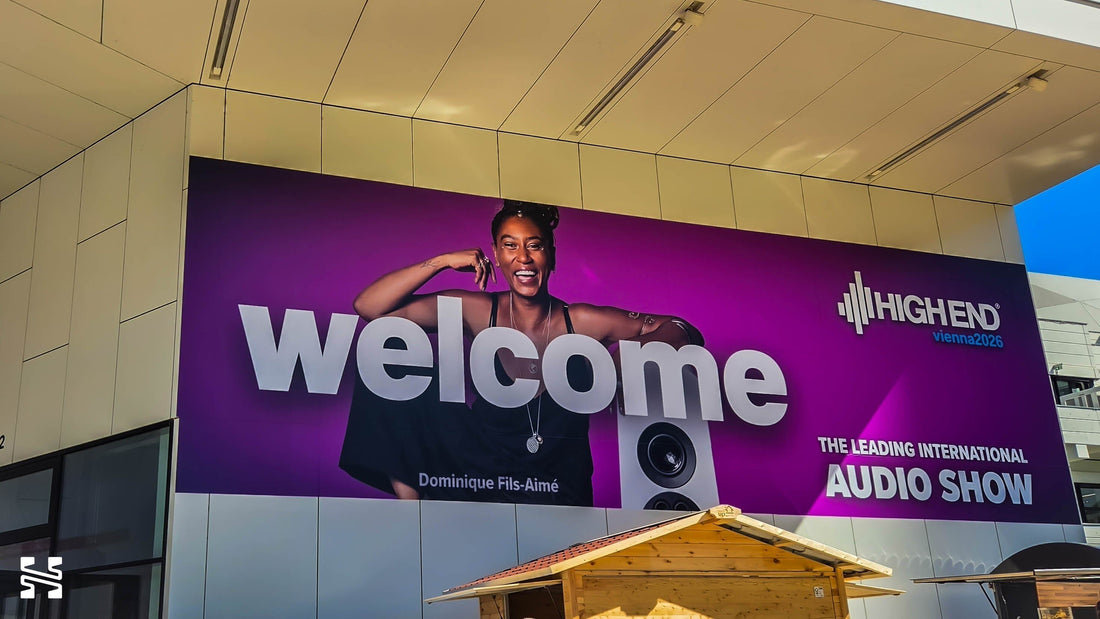
Vienna. The City of Music. How fitting that it is now host to the world’s largest hi-fi audio show after a relocation from its historic home in Munich. Though the venue has changed, its spirit has not. High End Vienna is truly a grand celebration of audiophile culture, for better or for worse.
This year, I had the opportunity to attend the show for the first time and try a myriad of wild and wacky audio gear as well as take a quick tour of Vienna. So join me as I recap my journey with a bit of a show and tell.
The Show Floor
First, let’s talk about how the show is structured. High End Vienna is set in the Austrian Center Vienna, a very large convention center with multiple floors stretched across a 30,000 SQM wide complex. There are five connected levels including an underground space. It’s a maze to get through.
Head-fi products (i.e. headphones, IEMs, and related source gear) received their own section separate from the more traditional audiophile gear of speakers, cables, and accessories. Unfortunately, this layout meant that head-fi was effectively isolated from the rest of the show and meant that visitors would need to make a conscious effort to visit the area rather than stumbling across it.

The various speaker rooms were impressive. Some rooms were grand affairs in cavernous halls. Others were noise isolated booths constructed right on the show floor amidst countless manufacturers and vendors vying for your attention. It’s incredible how High End Vienna managed to pack such a wide variety of spaces instead of mostly uniform hotel rooms like some of the other audio shows I’ve been to.
Despite having over 22,000 visitors, the show didn’t feel quite as crowded as reported in previous years. Due to the large venue and maze-like layout for visitors to disappear into, hallways weren’t jam packed shoulder to shoulder. It was nice that I could navigate without needing to force my way through a wall of bodies.
Impressions - Head-fi
During my time at Vienna, I tried over 20 different new things. It will not only be painful for me to write about all of them, but it will also be painful for you to read as well. So no particular order, here are some select impressions of the headphones and IEMs I tried.

Meze Audio Arta
The Arta is Meze Audio’s newest flagship open-back headphone. Coming in at 6,000€, it’s arguably the most hyped headphone to debut at High End Vienna.
My take on the Arta is that it’s a mature evolution of the Meze house sound. Whether that’s good or bad is up to you. I like it the most of any of the Meze headphones I’ve heard, though take it with a grain of salt as I’m far from a Meze connoisseur as their products are typically not my type of tuning.
The Arta has a bassy, boomy sound. Upper mids are quite relaxed, just shy of being buried. The upper treble provides some air and extension to help balance out the elevated low end. It’s a thick, enveloping, and fairly closed-in presentation. It’s not a headphone built to be “technically” proficient. But I don’t think people buy Meze for that, anyway.
Based on my discussion with the Meze team, the Arta is built on the Empyrean II platform but with the extra bass added in based on feedback Meze had received. Like I said, it’s their house sound done well. For those who love the Meze sound, I think this will fit the bill perfectly. Whether or not you can afford said bill is another question.

DCA Aeon Core
If the Meze Arta was the most hyped headphone to debut, I’d say the $899 closed-back DCA Aeon Core comes in second. It was announced a few hours before the show started, blindsiding many reviewers and attendees and generating quite a bit of a buzz.
Among the DCA headphones, I’d say the Aeon Core is one of my favorites. It’s just solid overall with nothing too weird going on. It is a bit of a lean headphone with a bit of that Harman target style lower mids with the dip. I presume the Aeon Core is going for some variant of Harman. To be honest, I was expecting the Aeon Core to be a warmer, bodied sounding headphone given its closed-back nature so the leanness caught me by surprise. It’s not bad, just unexpected.
Unfortunately, the treble did have some areas that didn’t quite agree with me and my head. There were some mid-treble peaks that stood out as fatiguing in some places. My uneducated guess is that however they tune the treble of their headphones, it’s like robbing Peter to pay Paul. It will work great on specific heads, but not mine.
For the staging presentation, it does have the limitations of a true closed-back (i.e. no cheating with venting). While the Aeon Core certainly does not feel claustrophobic or wholly pressed into your head, the lack of openness reminds me that I’m effectively wearing a “sound helmet”. Still, I don’t think it negatively affected the sound too much and I do applaud DCA for achieving this sound in a closed-back and without the use of their AMTS metamaterial technology.

RAAL Magna Evo I
When it comes to exotic headphones, RAAL is one of the most well-known with their ribbon driver technology. The RAAL Immanis debuted to great fanfare a few years prior, and now they have a new sub-flagship: the Magna Evo I. From what I can tell, it will cost $5,000 without its direct drive interface that connects to a traditional amplifier.
I heard the Magna Evo I off a Russian amp from a brand called Serbian Audio Equipment (SAEQ). The music selection at the booth was some extremely high quality audiophile recordings. It sounded exceptional - pure effortlessness in the lower mids for strings like cellos and violas. There’s an overall slight warm tilt with perhaps some peakiness in the treble as I noticed some sibilance in certain vocal tracks. Not huge peaks, just some of those super needle sharp ones dotting the treble spectrum.
As mentioned, it all sounded fantastic. But I couldn’t tell if it’s because these headphones were truly great or if it’s just these recordings being so beautifully recorded. This is a forever complaint I have with audio shows. As much as I want to listen to very good music, I also want to stress test the system to see if it will work with my own tracks.

HiFiMan HE6 Remastered
The HE6 Remastered is yet another headphone that made its debut at High End Vienna. Supposedly, the HiFiMan employees flew in with the first two units to enter the Western hemisphere. Yet those who have been around headphones long enough will know that the HE6 can’t truly be called a new headphone. But this iteration is welcome all the same.
Thankfully, the HE6 Remastered seems to be exactly what it says on the box. It’s brutally power hungry like the original HE6’s. It’s also pleasantly punchy and dynamic like the original HE6’s. Note however that like other HiFiMan products, the HE6 Remastered is a neutral-bright sounding headphone. It’s near ruler flat in the bass, so the perception of dynamism is a more subtle firmness in the weight of the notes rather than a boomy bass shelf.
Personally, the HE6 Remastered is what I’ve been hoping for. I’ll need to get a review unit in to see if there are any holes in my first impressions, but if they hold up, the HE6 Remastered will be one of my favorite HiFiMan headphones. That said, the price isn’t quite so friendly. Last I heard, it’s a little under 2,000€.

ArcTec Berlin AB92
Here’s an interesting headphone. The ArcTec Berlin AB92 is a 2,400€ planar headphone developed by Klaus Heinz, the ex-chief engineer at ADAM and HEDD Audio and pioneer of AMT drivers. So why a planar? According to Klaus, the most important thing is the sound quality, not the principle. It’s these planar drivers he’s developed that best achieves his vision, not the AMT drivers he was famous for.
Sound wise, the AB92 is a rather interesting headphone. It’s a warm, bodied planar with pulled back vocals and a couple patches of brightness in the treble. Listening to it across a few different tracks, I get the sense that if you’re into more traditional audiophile music or soft rock, the AB92 works quite well. But throwing on some more energetic, less nicely recorded pieces and the treble region can be a little rough. Stage presentation is nicely open and feels natural in that regard. I don’t think there’s another planar with this sort of tuning on the market which makes it fairly unique. Unfortunately, it is a bit of a heavy headphone. If I had to guess, it’s around 500+ grams. That said, the comfort is good. The suspension strap and pads do a great job of hugging my head.

FiiO/Jade Audio JT9 (Unreleased)
FiiO, along with their sub-brand Jade Audio, has made waves in the headphone scene as of late. Models like the FT1, FT1 Pro, JT3, and JT7 have all been well received as welcome additions to the market. So, why stop making more headphones?
Enter the JT9. Unfortunately, I was not a fan of this one. At first glance, it’s a regular V-shaped headphone with a hole in the mids. But the more I listened the more I just did not enjoy it. Bass quality was mediocre. Treble was rough with a scattershot of peaks. And the midrange just sounded off like something might not have been plugged in all the way.
To be clear, it wasn’t awful. But it was not good, and certainly not to the level I’ve come to expect from FiiO these days. Especially considering this is an open-back headphone. Now, it is an unreleased prototype, so FiiO still has time to work on this. It’s just disappointing to see that their highest end model in the Jade Audio line happens to be the worst one.

FiiO FT15 (Unreleased)
Luckily, FiiO redeemed themselves with the FT15. Or rather, I should say they didn’t make the same mistakes. Like the JT9, the FT15 has a bit more of a V-shaped slant to it with more emphasis on the bass and the treble. But it was much, much more palatable. The midbass has a good amount of punch to it. Midrange is pulled forward. The treble can be a bit fatiguing, but not in any one specific area that’s particularly offensive. It’s also a rather open sounding headphone, which I like.
Overall, I think this one needs a bit more time for development like the JT9. But they are on the right track. Pricing, on the other hand, will be a bigger question.

AUNE AR5000 MK2
Like FiiO, AUNE is a brand that’s been on the rise in the headphone scene. The original $300 AR5000 was well received as a competitor to the venerable HD 600. I suppose AUNE isn’t one to rest on their laurels as in just a couple years, they’ve come out with an updated version of the AR5000 based on customer feedback.
Personally, I think these changes are a sidegrade at best. They added a bit more bass to give it a punchier, weightier low end which I can appreciate. However, they didn’t fix some of the treble issues the original had around 5 kHz. Instead, they added more mid and upper treble. While the added treble does mask some of the peakiness, it introduces a different tonal profile that I can’t say is actually better.

AUNE AR9000 (Unreleased)
The AR9000 is AUNE’s flagship that's been in development for a couple of years now. Previously, it seemed to be positioned as a HD 800S competitor with a neutral-bright sound signature. But AUNE has decided to take a different approach and dampen the entire treble region to make it a more downtilted headphone. It’s a warm-neutral headphone with a bit of rawness in the mid-treble region. I’m hoping they price it at $800.

AUNE AR3000 (Unreleased)
After trying the AR5000 MK2 and AR9000, I was persuaded by the AUNE rep to try the AR3000. I had low expectations going in. What I got was an excellent headphone. It’s a bassy, bodied sound that retains good midrange clarity and treble presence without feeling muddy or overly dampened. There is a peak somewhere in the treble that gives sibilance, but it’s more of a thin, needle sharp peak rather than big harsh regions.
Price hasn’t been determined yet, and this is still a prototype, but it’s most likely going to be cheaper than the AR5000. I’m in favor of them releasing it as is lest they do anything unnecessary to the sound à la the AR5000 MK2.

A&K x 64 Audio Xio
I’ve tried almost every modern 64 Audio IEM, but somehow the $3,000 Xio escaped me. Probably because it’s rather new and it’s in collaboration with A&K which limits how accessible it is. But I’m glad I finally had a chance to listen to it at High End Vienna. From the moment I put them in, it was a comfortable, enjoyable experience.
It’s through and through a 64 Audio IEM. There’s the signature house sound of a bodied low-end, relaxed upper mids that center closer to 2 kHz, and some upper treble air from their BA drivers. It’s like a cross between the U4s and the Volur. It trades some of the macrodynamic energy of the Volur with the balance of the U4s’ tuning. What I particularly like about the Xio is that its upper treble peaks are pushed very high up to around 15+ kHz so it doesn’t annoy me like some of 64 Audio’s other IEMs. Perceived technicalities are good, just like the other 64 Audio products, though not on the upper levels like the U12t. From my brief time with it, I’d say the Xio is among my favorite of the 64 Audio IEMs.
Impressions - Speakers
I like to think I take headphones and IEMs fairly seriously. But when it comes to speakers, anything goes. And boy did anything go at High End Vienna. Here’s just a fraction of what was on display.

ESD Super Dragon
This is a 3.6 million dollar system. Did you expect less from a set-up that looks like that? Unfortunately, my time with these speakers was a let down. Not because they sounded bad, but because it was accompanied by pure audiophile waffling. We had a 20 minute spiel about the product before handing the reins over to a journalist who played some of the most bizarre music.
The brief moment where we did play something normal (i.e. classical), the Super Dragon sounded great. There’s a subtly rich midrange tonality with a naturalistic roll-off in the treble free of any peaks. The presentation was wholly enveloping with an absolutely immense sense of scale. But it’s perhaps because of that that the imaging is oddly non-existent with stereo panning being vaguely left or right. It felt more like being in an auditorium listening to massive PA speakers with how much volume these speakers were throwing out.
Alas, a potentially amazing experience ruined by the annoying parts of audiophile culture.

Audeum Audio Museum
This showroom was all about showing off the Western Electric 22B horn system developed back in the 1930’s. Very cool. It felt like walking into a time capsule to see these old wood panels, massive horns, and raw driver coils right behind them. Sound wise, there was a very stereotypical old-timey feel. There’s an N-shaped sound with roll-offs at both ends. I can’t say I’d enjoy listening to it for an extended period of time, but there is certainly a charm being in 2026 listening to these speakers that sound like they’re right out of vintage movies.

Avantgarde Acoustic Opus1
I was very pleasantly surprised with these speakers. The Opus1 has a curious look with a traditional box cabinet except with large horns grafted at the top. Funny enough, the Opus1 might be their most normal looking speaker as I only walked into their showroom thanks to all the exotic horn systems Avantgarde was showing outside.
The Opus1 felt extremely well integrated into the room it was in. It painted a cohesive, coherent sound that seemed at odds with the looks of this speaker. The test tracks were deep, bassy instrumental pieces and the Opus1 delivered. It was rich and bodied in a way that glues together the whole room. The horns did a good job throwing sound and creating a very convincing center image without feeling overly directional or beam-y.
At $18,000, it is an expensive pair of speakers. But compared to all the other crazy systems at High End Vienna, the Opus1 seems downright reasonable.

Silent Pound Bloom
This was another pair of speakers I was quite surprised by. Though they look like a box on stilts, the energy and dynamics they were able to present was quite impressive. Notes were very punchy - tight and incisive. While the Bloom definitely leaned on the brighter side, it was a good coloration rather than feeling like a compromise. There’s a fun, addictive character to its sound. Like the Opus1, I can see the $18,500 Bloom being a system in serious contention for those with deep but not necessarily ginormous pockets.
However, I would say it could have benefitted from a subwoofer in the room. I also got the sense that the soundstage and imaging was rather contained to the distance between the speakers itself rather than spreading out and truly filling the room.

MBL 101 X-Treme MKIII
These very sci-fi electro-tower looking speakers are the flagship Radialstrahler system from MBL and cost roughly half a million dollars. They’re omnidirectional speakers that throw sound every which way to immerse the room. Imaging was uncanny as it felt like music was coming from everywhere at once and didn’t change no matter where I moved around the room. The tonality is forward in the midrange with a bodied low end presence. Treble wise, there’s sharpness in the lower treble but seems to roll-off more at the top end for a darker overall presentation.
There’s a very unique timbral coloration to the instruments that I can’t describe. It’s like a slightly out-of-phase feeling combined with a grittiness in the lower mids. While not entirely natural, I can see an acquired taste quality to it. This is a system I’ll need to spend more time with to wrap my head around what I’m hearing.

Clarisys Audio Auditorium MK2
Of everything that I heard, these speakers might have been the most disappointing. The Auditorium MK2 are a pair of large ribbon speakers similar in concept to Magnepans. Overall tonality was OK, if a bit bright. But there was next to no subbass or rumble, though that could be excused given that these sort of speakers aren’t engineered for that.
My real complaint is that the sonic representation felt very flat - no staging, depth, or dynamic impact. Which was all the more unfortunate given that the showroom was playing modern electronic-style music. It was being powered off a Wadax source stack which did a good job I suppose as it did get very loud. I do wonder if I was “missing” something.

Raidho X2.8
Raidho debuted a new pair of speakers at High End Vienna - the Raidho X2.8. These were excellent. Great tonal balance all around paired with clean soundstage and imaging presentation. Treble is smooth with a hint of sweetness that accentuates certain notes. Bass was high quality - tight and firm in its response, but perhaps a little lean sounding where a subwoofer might have helped with the large room we were in. Shoutout to the rep who let us play Big John on the system.

Conclusion
I hope that these impressions inspire you to make the trip over if you ever have the chance! I’ve been to a few audio shows in the past but nothing comes close to the sheer scale of High End Vienna. Even over four days, I wasn’t able to explore every single floor. I suppose that’s an excuse for me to revisit next year! Vienna is a beautiful city and I could write a whole other article about the places I went and the food I ate.
But as always, the best part about these events is the chance to meet fellow audio enthusiasts and share in the passion for sound quality. If we ever cross paths at a show, don’t be afraid to come and say hi!

