Aune Audio
Aune Audio YUKI Portable DAC and Headphone Amplifier


Aune Audio YUKI Portable DAC and Headphone Amplifier
Aune Audio YUKI Portable DAC and Headphone Amplifier
No Fee 365-Day Returns*
Don’t love it to start? Don't worry, you have 365-days to return with no fees*.
Amplifier type
More information
Translation missing: en.products.product.amplifier_type_info
Solid-state
Connectivity
More information
Connectivity refers to the method in which the headphones connect to the audio source. Headphones can be either wired or wireless.
Wired
Portability
More information
DACs and amplifiers can either be carried around or meant for static desktop use
Portable
Description
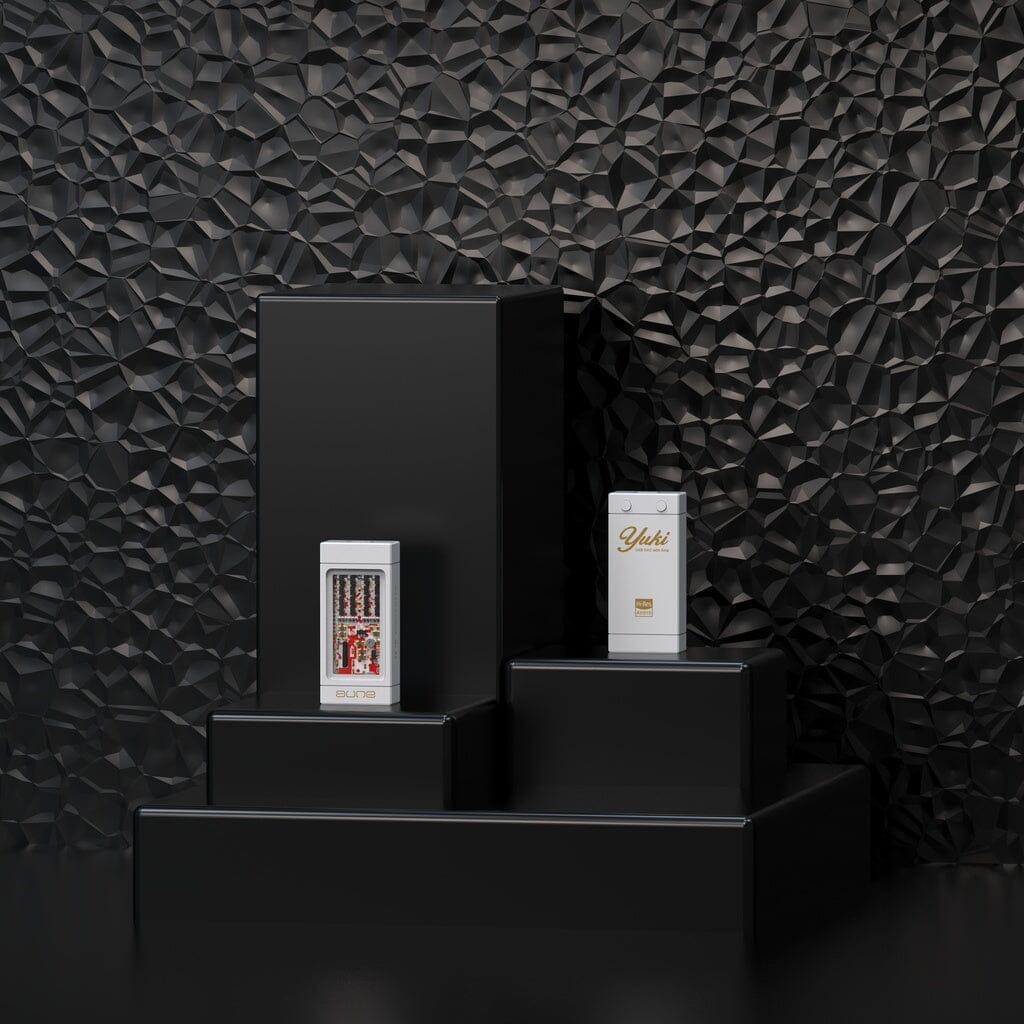
The Aune Audio Yuki is a portable USB DAC and headphone amplifier built around a choice almost nothing else in the dongle category makes: a fully discrete balanced amplifier with 16 transistors, the kind of output stage normally reserved for desktop gear. Aune then puts the analog board on display through a glass window in the snow-white aluminum shell, so the engineering is also the design.
Yuki connects over USB-C to smartphones, tablets, laptops, and Nintendo Switch, and feeds IEMs or headphones through 3.5mm single-ended and 4.4mm balanced outputs. It is made for listeners who want their in-ear monitors to sound like they are plugged into a serious system, wherever the music actually happens.
A Desktop Amp Idea in a Pocket Device
Most compact USB DACs combine conversion and amplification into a single highly integrated chip, because space and USB power leave little room for anything else. Aune splits the Yuki into two stacked boards instead: one layer for USB input and digital-to-analog conversion, one dedicated entirely to the analog amplifier. The amp layer carries 16 discrete transistors arranged as four independent amplification paths.
A dual-boost converter generates positive and negative 5V rails for that amplifier, giving it more voltage headroom than a circuit running straight off standard USB power. The analog board is built on a hybrid ceramic PCB, chosen for its thermal conductivity, insulation, and low dielectric loss, which helps the circuit stay consistent and preserves fine high-frequency detail.
Two DAC Chips, One Per Channel
Yuki uses two Cirrus Logic CS43198 DAC chips with one dedicated to each channel, so left and right are converted on completely independent paths. Keeping the channels separate improves stereo separation and dynamics, which is exactly what preserves the sense of instruments occupying distinct places in a recording.
Playback support covers PCM up to 32-bit/768kHz and DSD256, with Hi-Res Audio certification. Lossless streaming from a phone, a high-resolution library on a laptop, and DSD files all stay within what the hardware can decode natively.
Quiet Enough for the Most Sensitive IEMs
Sensitive in-ear monitors reveal amplifier noise as a constant background hiss, so a portable DAC lives or dies by its noise floor. The Yuki measures approximately 2.9 microvolts of output noise with THD+N of 0.00033% at 1kHz, quiet enough that reverb tails, room sound, and positional cues sit against silence instead of static.
The 4.4mm balanced output puts all four amplifier paths to work with balanced IEM and headphone cables, while the 3.5mm jack covers standard cables without an adapter. Two hardware buttons handle volume directly on the unit, no companion app required.
Phone, Laptop, and Nintendo Switch
Connected to a phone or tablet, Yuki takes over from the device's internal audio with its dual-DAC conversion and discrete amplification. Beside a laptop it works as a compact desk source for after-hours listening. UAC1.0 support means it also works with Nintendo Switch, where the low noise floor and channel separation keep game audio detailed and precisely placed.
Yuki is honest about its scope. It is built to make IEMs and efficient headphones sound their best, not to replace a desktop amplifier for power-hungry planars, and within that scope it applies engineering most of the dongle category skips. Our portable DAC and amp collection covers the step-up options when you need more output.
How Yuki Compares
Dongles at this level usually reach for integrated solutions, like the current-mode amplifier modules in the Questyle M15i. Yuki's discrete transistor stage is the outlier approach, and it is the reason the device sounds and looks the way it does: an analog-first presentation from a board you can literally see through the window. Our Dongle Wars Buying Guide maps out how the category's main contenders differ.
At $169, Yuki sits in the heart of the serious-dongle bracket and makes its case on architecture and tuning rather than raw output. Aune voices its products against real instrument recordings, and the goal here is the same as in its desktop line: natural timbre and musicality first.
Key Features
- Portable USB DAC and headphone amplifier
- Dual Cirrus Logic CS43198 DAC chips, one per channel
- Fully discrete balanced headphone amplifier with 16 transistors
- Four independent amplification paths
- Dedicated dual-boost converter generating positive and negative 5V rails
- Dual-layer structure separating digital and analog boards
- Hybrid ceramic PCB for the analog amplifier
- PCM up to 32-bit/768kHz and DSD256 with Hi-Res Audio certification
- Approx. 2.9uV output noise; 0.00033% THD+N at 1kHz
- 3.5mm single-ended and 4.4mm balanced headphone outputs
- UAC1.0 support for Nintendo Switch
- Works with smartphones, tablets, computers, and laptops over USB-C
- Hardware volume buttons, no companion app needed
- Aluminum alloy chassis with baked snow-white finish and glass circuit window
Technical Specs
| Product Type | Portable USB DAC and headphone amplifier |
| DAC Chips | Dual Cirrus Logic CS43198, one per channel |
| Maximum PCM | 32-bit/768kHz |
| Maximum DSD | DSD256 |
| Amplifier | Fully discrete 4-way balanced, 16 transistors |
| Amplifier Power Supply | Dual-boost converter, positive and negative 5V rails |
| Circuit Structure | Dual-layer, digital and analog boards separated |
| Analog PCB | Hybrid ceramic |
| Headphone Outputs | 3.5mm single-ended, 4.4mm balanced |
| Output Noise | Approx. 2.9uV |
| THD+N | 0.00033% at 1kHz |
| USB | USB-C; UAC1.0 support for Nintendo Switch |
| Controls | Hardware volume buttons |
| Chassis | Aluminum alloy, baked finish, glass window |
Reviews