Aune Audio
Aune Audio S17 Pro EVO Headphone Amplifier


Aune Audio S17 Pro EVO Headphone Amplifier
Aune Audio S17 Pro EVO Headphone Amplifier
No Fee 365-Day Returns*
Don’t love it to start? Don't worry, you have 365-days to return with no fees*.
Amplifier type
More information
Translation missing: en.products.product.amplifier_type_info
Solid-state
Connectivity
More information
Connectivity refers to the method in which the headphones connect to the audio source. Headphones can be either wired or wireless.
Wired
Portability
More information
DACs and amplifiers can either be carried around or meant for static desktop use
Not Portable
Description
The Aune S17 Pro EVO is a fully discrete, fully balanced headphone amplifier that delivers up to 7.5 watts into 32 ohms, with a measured noise floor of about 3.6 microvolts. That is enough power for demanding planar magnetic headphones and a quiet enough background for sensitive in-ear monitors.
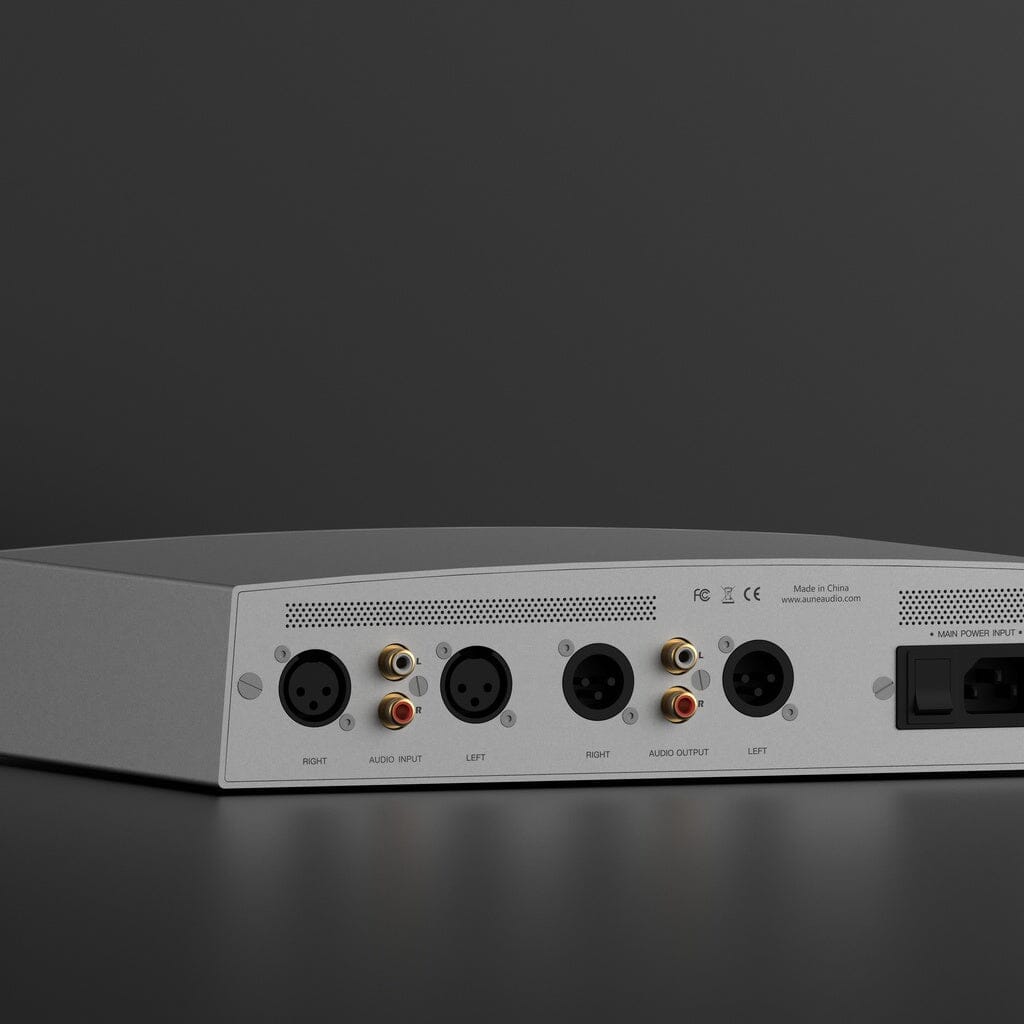
The S17 Pro EVO is the amplifier half of a serious desktop system. There is no DAC inside: connect any DAC or streamer through RCA or balanced XLR, and it drives headphones from three front-panel outputs or works as the preamp for powered speakers. It replaces the original S17 Pro, keeping the same circuit and adding the features the original lacked.
Class A Operation and Heat
In a Class A amplifier, the output transistors carry current all the time, whether music is playing or not. This avoids crossover distortion, a small error that can occur when transistors hand the signal back and forth, and much of the warm, smooth, dense sound Class A designs are known for comes from it.
Aune publishes how far the S17 Pro EVO runs in Class A. From the balanced outputs, it stays in Class A up to 2.07 watts into 32 ohms and 4.14 watts into 64 ohms, and headphones above 155.6 ohms balanced or 77.8 ohms single-ended stay in Class A all the way to full volume. Beyond those levels the output stage moves into Class AB to deliver the rest of its 7.5 watts. Two watts is more than most headphones draw at normal listening levels, and a 300 ohm headphone like the HD 800 S stays in Class A at any volume.
The current that flows through the output transistors at idle is what makes the heat. Two bias settings control it: A-L runs 100mA per channel, and A-H doubles that to 200mA for a fuller sound with more body. Heatsinks, a bottom heat plate, and the chassis form one cooling structure vented through the rear panel. If the internal temperature reaches 69C, the amplifier switches itself back to A-L. It runs warm, so give it some space on the desk.
Twin JFET Input and Output Stage
Aune builds the input stage around matched twin JFET transistors. JFETs combine very high input impedance with a naturally smooth transfer characteristic, which is why their sound is often compared to vacuum tubes. Using two thermally matched devices keeps the circuit's midpoint voltage stable, so the sound stays consistent as the amplifier warms up.
The output stage uses two parallel pairs of transistors per channel, 16 output transistors in total across the balanced circuit, fed by a 50 watt low-ripple toroidal transformer and a 19,200uF capacitor bank. The digital control circuitry has its own power supply, separate from the analog side, to keep interference out of the audio path. Aune specifies THD+N below 0.00016% at 1kHz from the balanced output.
Power for Demanding Headphones
Inefficient planar magnetic headphones like the HIFIMAN Susvara need an amplifier with serious current. From its balanced outputs, the S17 Pro EVO delivers 7,500mW into 32 ohms and 2,673mW into 100 ohms. High-impedance dynamics are covered too: 918mW into 300 ohms is far more than a Sennheiser HD 800 S needs. You can check your own headphones against these numbers with our headphone power calculator.
Two gain levels, 8.9dB and 13.6dB, make that power usable across the range. Low gain gives IEMs and efficient headphones finer volume steps and a quiet background, and high gain opens up the full 7.5 watts. Headphones connect through 4-pin XLR balanced, 4.4mm balanced, or 6.35mm single-ended outputs on the front panel.
R2R Volume Control and Display
Volume is handled by a four-way balanced R2R resistor network built around a JRC volume chip with dedicated op-amps. A conventional potentiometer can drift out of balance at the bottom of its range. The R2R control keeps left and right matched at low volume, which matters most for late-night listening and sensitive IEMs.
One multifunction knob handles volume, input, bias current, and settings, and a 4-inch display shows input, gain, current mode, volume, and internal temperature. The screen turns blue in A-L and red in A-H, it can switch itself off after 30 seconds, and the all-aluminum remote covers the main controls from across the room.
Preamp Outputs
The S17 Pro EVO also works as an analog preamp. Headphone and preamp output are selected separately, and each remembers its own volume, so switching to powered speakers does not start at your headphone level. Balanced XLR and RCA preamp outputs feed active monitors or a power amplifier, and the two line inputs let a balanced DAC and a second source stay connected at once.
In an all-Aune system it pairs with the AR9000 flagship open-back, and its balanced output has plenty of power for that headphone's 50mm carbon fiber driver. It works just as well with any DAC you already own.
What Changed from the S17 Pro
Compared with the original S17 Pro, the EVO adds independent switching between headphone and preamp output, separately stored volume for each mode, and an automatic screen-off function. The component count rises from 635 to 657, and the fully discrete circuit, twin JFET input, and 7.5 watt balanced output stage carry over unchanged.
At $799, the S17 Pro EVO has enough clean power for nearly any headphone we sell, a Class A range that covers most listening, and preamp outputs for a pair of powered speakers.
Key Features
- Fully discrete, fully balanced headphone amplifier and preamp
- Up to 7.5W balanced output into 32 ohms
- Class A up to 2.07W into 32 ohms balanced; full Class A above 155.6 ohms balanced or 77.8 ohms single-ended
- Matched twin JFET input stage for a smooth, tube-like character
- 16 output transistors, two parallel pairs per channel
- Selectable bias current: A-L 100mA or A-H 200mA per channel
- Automatic step-down from A-H to A-L at 69C for thermal protection
- Four-way balanced R2R volume control with precise low-level channel matching
- Two gain levels (8.9dB / 13.6dB) covering sensitive IEMs to demanding planars
- Approx. 3.6uV output noise; THD+N below 0.00016% balanced
- 4-pin XLR, 4.4mm balanced, and 6.35mm headphone outputs
- Balanced XLR and RCA inputs; XLR and RCA preamp outputs
- Independent headphone and preamp modes with separate volume memory
- 50W low-ripple toroidal transformer with 19,200uF capacitor array
- Integrated three-dimensional cooling structure
- 4-inch color display with two-color current-mode UI and temperature readout
- Multifunction knob and all-aluminum remote control
- Hi-Res Audio certification
Technical Specs
| Product Type | Headphone amplifier and preamplifier |
| Architecture | Fully discrete, fully balanced |
| Class A Operating Range | Balanced: up to 2.07W at 32 ohms, up to 4.14W at 64 ohms; full Class A above 155.6 ohms balanced / 77.8 ohms single-ended |
| Input Stage | Matched twin JFET |
| Output Stage | Two parallel pairs of transistors per channel, 16 total |
| Bias Current Settings | A-L (100mA per channel) / A-H (200mA per channel) |
| Thermal Protection | Auto switch from A-H to A-L at 69C |
| Gain Settings | Low 8.9dB / High 13.6dB |
| Volume Control | Four-way balanced R2R, JRC volume chip with dedicated op-amps |
| Headphone Outputs | 4-pin XLR balanced, 4.4mm balanced, 6.35mm single-ended |
| Line Inputs | RCA (10K ohm) and XLR (10K ohm) |
| Preamp Outputs | RCA (200 ohm) and XLR (100 ohm) |
| Headphone Output Impedance | 1 ohm |
| Frequency Response | 20Hz - 80kHz, +/-0.05dB |
| THD+N | <0.00016% at 1kHz (balanced); <0.0003% at 1kHz (single-ended) |
| SNR | >116dB (balanced); >115dB (single-ended), at 600 ohms |
| Output Noise | Approx. 3.6uV |
| Power Supply | 50W low-ripple toroidal transformer, 19,200uF capacitor array |
| Display | 4-inch color display with auto screen-off |
| Dimensions | 288 x 211 x 63mm |
| Remote | All-aluminum remote control included |
Headphone Output Power (High Gain)
| Load | Single-Ended Output | Balanced Output |
|---|---|---|
| 32 ohms | 2,050mW | 7,500mW |
| 100 ohms | 688mW | 2,673mW |
| 300 ohms | 235mW | 918mW |
| 600 ohms | 117mW | 459mW |
Reviews