Noble Onyx Review: Mold Breaker
Noble's Onyx breaks the mold for summit-fi IEMs, offering an unapologetically warm, but deftly-refined tuning with large sonic images, effortless timbral coherence, and a molasses-thick bass presentation.

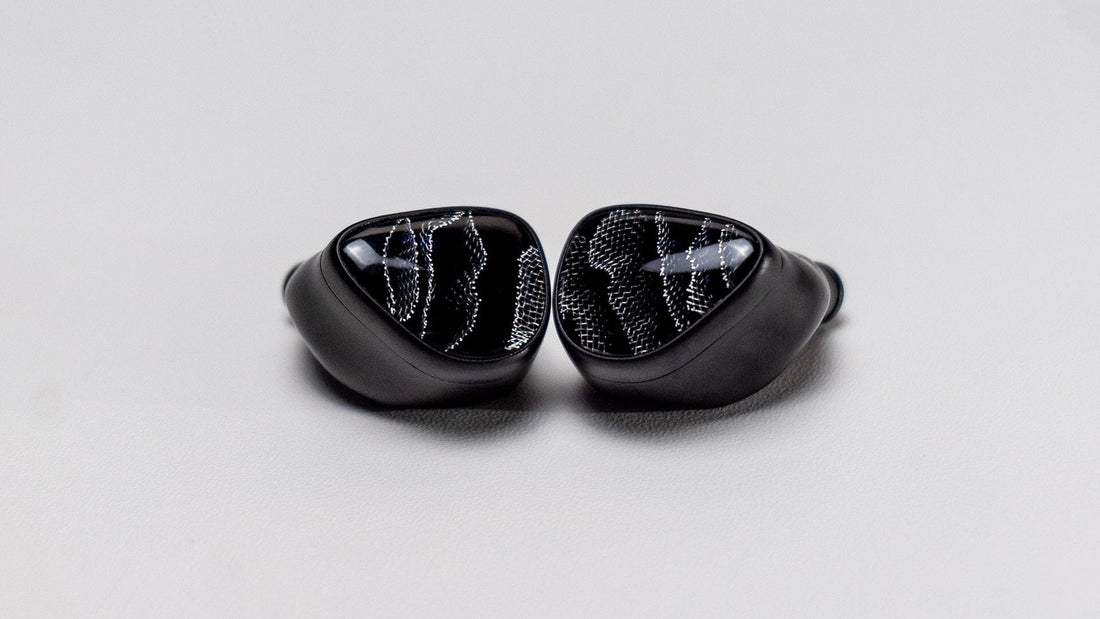
Expensive IEMs are often the most colored, idiosyncratically-tuned IEMs out there, so they and I tend not to get along all that well. For that reason, it may be surprising for readers to learn that Noble's $3,200 USD quadbrid IEM Onyx is actually one of my favorite IEMs, and it's because of its colorations, not in spite of them.
Simply put, I think this IEM sounds awesome. But it sounds so good because it deviates in important ways from what we on the Headphone Show content team have often called "neutral." While there’s tons of colored options out there, Onyx does so in ways that are not only sensible, but constitute one of my favorite approaches out there.
So let's dive in and unpack what is potentially the most expensive IEM I can say I genuinely really like.
What we like
- Sonic elements are presented with incredibly engaging size & visceral texturing
- One of the few IEMs I’ve encountered with a consistently novel imaging presentation
- Nozzle profile/angling works very well for my ears; consistently comfortable & secure fit
What we don’t like
- This one's expensive; I would personally never spend this much on an IEM
- Venting is very minimal; it is technically vented but the IEM itself does have considerable driver flex & occlusion effect when worn
- Potentially too warm for some
Build, Comfort, Design, & Accessories
Touching on design first, I love the way this IEM looks. This is one of the few times where I feel like the faceplate has a really eye-catching textural contrast with glints and glimmers peeking out, but is also handled with sufficient restraint—limiting the colorway to black and white, making the shiny bits more so "peppered throughout" than "defining the design" are choices that make this feel balanced between "complex" and "refined."
What's especially interesting is that the faceplate is actually made of wood, which I never would've guessed just from looking at it! It initially looks like metal flake or something, but it's actually made from a stabilized wood-resin composite material called Raffir that I'd never heard of until now. This is rare for me, but this is one of the few times where a "luxury" touch like unique material does add materially to how much I enjoy using the product (even if it has nothing to do with sound quality).

While the design is awesome, the build is no slouch either. Onyx is made of what seems like thick/sturdy aluminum and it has a satisfying weight in the hand when putting it in the ear, while thankfully not being heavy enough to be distracting while worn. While the IEM itself has gentle molding and isn't massive or anything, I did find the act of placing it into the ear to be a bit clunky the first few times until I learned the angle of the nozzle (after which point, it became very comfortable). I think because the angle of the nozzle isn't super common and its quite long, it may prove vexing at first. However, once I got used to it, it became a lot quicker to pop these in to listen for long periods without complaints.
Which brings me to the comfort, which I'd say is pretty good except for one major caveat. The good here is that again, the shell isn't massive (medium-large at the biggest) and the contouring of the shell itself does mean it nestles rather neatly into my concha. However, the biggest issue here is that the IEM's venting is on the very gentle side, which is to say it feels very close to un-vented, and as a result there's palpable occlusion effect, noticeable driver flex, and an ear-sucking sensation when placing the IEM in the ear, all of which are typical of unvented (or mostly unvented) designs.

This is a shame because if it had better venting for the front volume, I think this IEM would be close to a home run for me comfort-wise, but unfortunately it does have this one downside that people are going to need to be aware of before purchasing.
In terms of accessories, Onyx comes with a pair of generic medium bore tips attached in the box, while the accessories package itself comes with two types of silicone tips in multiple sizes for each, as well as a full complement of foam tips. It also comes with two cases—a big one that houses essentially the whole retail package, and a smaller one for carrying—and I like this because it means purchasers can have a more robust "archival" case for long-term storage, or have a smaller on-the-go case for portable use.
I honestly found the stock tips it came pre-installed with to work perfectly well for me ergonomically & sonically, so while I did measure the stock narrow & wide bore tips just to see what effects they had, the listening impressions in this review will be given with the stock medium bore tips included on the IEM itself when unboxed.

Lastly, it comes with an Eletech cable that I find perfectly adequate for use in terms of comfort/weight, but the hardware is pretty ugly and I don't love having to use 4.4mm termination on an IEM that isn't hard to drive at all. I heard a really good joke on Discord the other day, which I’ll paraphrase now as “Audiophile cable companies exist to collaborate with existing IEM brands to drive up the MSRP of the IEM while packaging it with a worse cable than it would’ve come with otherwise”. While I think this Eletech cable is… fine, I can’t help but wonder how much its inclusion drove up the price versus if Noble had just gone with something simpler.
Overall, I think the unboxing and user-experience with the Onyx is going to be positive for most people shopping in this price range; it has enough accessories (and the right kind of accessories) that most people will probably have their expectations met, if not exceeded, and the comfort/industrial design of the IEM is clearly well-considered enough that it's neither unnecessarily huge nor weirdly-shaped, which means it's wearable for long periods of time. The real caveat here is the lack of sufficient venting, everything else seems like very minor downsides which are quite personal/unlikely to be shared by everyone.
Sound

Hooooo boy, she thicc!
Jokes aside, this is a firmly, proudly warm-tuned IEM and I think most people’s first impression hearing Onyx is going to be some version “sheesh, this is super thick/warm sounding.” And honestly, while I’m down with this presentation for more reasons than one, I have to acknowledge that it won’t be for everyone. That said: hear me out.
The TL;DR I’d give for this IEMs tuning is that it’s possibly the most refined approach to an unapologetically warm IEM I’ve seen. It balances the largesse of images, punch and heaviness of transients, and relaxed timbre that people like about warm tunings while accepting few of the downsides typical of super-warm tunings.
Surprisingly, I don’t really get much of a lack of intelligibility at all despite the large dip in a range usually necessary for this quality. I don’t hear a cloying sense of stuffiness or muddiness, and I also don’t feel a subjective lack of “detailing” on smaller cues of the music I’m listening to.
While I usually like to start from the bass frequencies and how they color the presentation on their own, this is an IEM where all of the colorations are so dramatic/immediately noticeable, but also deeply intertwined & interdependent, that I feel like it makes more sense to just discuss the overall presentation and not restrict myself to talking about just one area of the frequency response.
If I had to distill Onyx’s sonic character down to one term, it would actually be “realistic.”
Do me a solid and stow away the pitchforks for a second.

While yes, Onyx has several other presentation quirks, one of the most consistent impressions I get while listening to it is that the sonic images themselves come across as if they have more opacity, tangibility, and yes, realism to them than usual. Almost as if they’re truly, physically present playing in a room inside my head instead of the typical badly-binauralized stereophonic reproduction of IEMs. This impression is no doubt influenced by the tuning being idiosyncratic as hell, but somehow Onyx is also a case where the frequency response measurement looks like it would come across a lot more colored than it actually does.
So let’s talk about the tuning. While yes, Onyx is doubtlessly a warm IEM, I can’t help but feel like it’s not massively warmer than a lot of the tunings I like, and there are a few reasons for this.
The first is that while Onyx has a sizable bass shelf, the shelf itself doesn’t really bleed all that much into the lower midrange, finding its crest right around 300 Hz. This means unlike other IEMs that try to maximize bass hugeness and presence by just tacking a massive, unwieldy shelf on there, the balance between the bass and center midrange is almost… typical for this market. A 10dB bass shelf with a corner frequency centered around 100 Hz is so common it’s almost pedestrian.
Now that said, fundamentals do still get an extra push, no doubt. But I never felt like the midrange was uniquely overpowered or drowned out; the voice of stringed instruments, the wooden heart of drums, the core of vocalists were all not only present, but presented with a damn solid balance relative to the generous bass emphasis.
And this is Onyx’s first trick: instead of tacking on a gigantic, plodding bass shelf on there that reaches well into the midrange, it sports a fairly typical bass shelf, but elevates that bass shelf as well as the center midrange firmly above the rest of the tuning, such that the listener does get palpably warm, bassy response, but without abandoning balance between its two elevated regions, and thus, without ruining the timbre from 20-2000 Hz.

Which brings us to the rest of the midrange, which is probably the main thing that’ll confuse people.
That massive cut in the 3 kHz region? I kind of hear it, but weirdly it doesn’t have any ruinous effects on the timbre of most instruments, and surprisingly, even the things I’m most sensitive to like vocalists & snare drums only sound slightly relaxed/softened.
Some will surely hear this dip’s contributions more aggressively than I do, which means for them, Onyx is likely to be too relaxed, or downright muffled. But I was genuinely very surprised when I played my reference tracks and the vocal timbre across them seemed totally intact, if slightly chilled out and “glowy” as opposed to truly transparently reproduced.
I don’t know if it’s because of where the 3-4 kHz cut is placed or something else, but honestly the main contribution I seem to get from this coloration is, as mentioned, that it tilts the entirety of the response towards the center-midrange and bass (not just bass), while also bringing the mid-treble slightly more forward… and this is a signature I can get down with. It’s bassy, but not because it has 20 dB of bass. It’s almost Audeze-like in that everything below 2 kHz gets a somewhat even amount of push, which means instead of the plump, rotund, bouncy bass boom typical of large bass elevations, instead Onyx presents as much chestier, fuller, and more replete with texture than typical “basshead” IEMs.
There may be other reasons for this dip not sounding as big as it measures for me—I would put money on my eardrum having a higher acoustic impedance around 3.2 kHz than the 5128, which would result in more energy in this band than shown in the measurements (its an area my ear often has a narrow peak that isn’t shown on 5128)—but since all I can do is honestly report my impression, I can only say that this upper midrange coloration simply works really well for me, even if I do hear it as a minor coloration.

And it’s not that it just works in a “timbre” way either. The choice made by whoever tuned Onyx to get most of the IEM’s warmth from this dip seems to result in both a consistent sense of spaciousness and a palpable sense of imaging realism, as well as a unique presentation of dynamic heft.
As I said earlier, images have this sense of unique tangibility and presence to them that’s entirely unique to Onyx vs. other IEMs I’ve heard that makes it basically impossible not to gush a bit about this aspect, while it also presents kick and snare drums with a sense of largesse, perceived mass, density, and decay that I think I’ve only really experienced on speakers.
Which brings me to the treble, where I am once again going to applaud the choices made, because this is typically where superficially-similarly tuned sets (Unique Melody MEST series, Campfire Andromeda 2020, Sennheiser IE series) have all fallen flat on their face for me, ruining any chance of this unique approach to bass-midrange balance being heard as anything other than “incoherently bright.”
Instead of erroneously thinking this approach would be “too warm to be likable by the majority” and thus, balancing it with a ton of mid-treble or upper treble, Onyx is downright polite above 5 kHz, allowing the overall tonal signature of this IEM to be “coherently warm” instead of “incoherently V-shaped.”

Now, obviously this is a warm IEM, but I never felt like the chain rattle or snap of snare drums, the fricative crackle of intimate vocalists, or the sizzly sheen of cymbals was anywhere near missing.
In fact, it’s another reason I love this IEM so much; I find it a little bit pushed in the treble, but if anything I find the mid-treble to be the focus here instead of upper-treble. While the latter is still present, but neither is overpowering, I’d still say there’s a slight focus on mid-treble and upper-treble that makes Onyx replete with all of the characteristic detailing, texturing, and nuance that allows for both distinction of individual instrument identity, as well as a sense of “unveiling” for smaller, missable cues in the music.
Now, if you’re looking for a “fast” IEM… yeah, that’s not Onyx. It’s much more focused on organic-sounding decay and a mix of timbral/imaging realism than presenting things as quick or nimble. That’s something I like about it, but of course not everyone is searching for that sort of thing.
When it comes to the sound quality of Onyx, of course I also can’t really guarantee that it’ll sound similar to anyone reading this; certainly some people will find it too dark, some will find it too bassy… but for me, Onyx is approaching a genius-level balance that I honestly can’t say deserves anything less than a slow clap for how big of a risk it takes and how much it pays off for me. Certainly it’s not an uncolored, neutral presentation that presents everything equally, but the balance here is a masterclass in finding a way to have your cake (what people call “technicalities”) and eat it too (coherent timbral balance).

Comparisons
But… we have a problem: I don’t have anything nearly this expensive around to actually put in what some would call a “fair” head to head with Onyx.
Now personally, I’m not a “price = sound quality” person; I almost always opt to just compare the IEM I’m reviewing to other things that seem to be going for a similar thing. The problem is that Onyx is so unique that I don’t have anything on hand that could reasonably be called “similar,” especially because everything I’ve ever seen that seems to go for a somewhat similar approach to Onyx doesn’t work nearly well enough for me to feel like I want to keep it around.
If I could, I’d be comparing it to the Symphonium Meteor (big upper treble problem for me), Nightjar Singularity (overblown bass & midrange/treble coherence issues), or the Empire Ears Legend EVO (again, brighter than I’d like), but I can’t get hands on these in time to finish this review. So instead I’m just going to put it in as unfair a comparison as possible, by comparing it to my absolute favorite IEM of all time.
vs. Prisma Lumen
So yeah… Lumen is much, much more neutral. It’s a better fit for my library—which has a lot of different types of music in it—and if I had to choose one, whether for my own collection, or for recommending it to others, Lumen would be my pick hands down…
…so why do I find myself reaching for Onyx so often when Lumen is right there on the desk next to it?

Well, Onyx does a whole bunch of stuff that Lumen simply doesn’t do—huge images, massive bass, a more novel treble presentation—while never abandoning a sense of sonic balance from top to bottom and, importantly, still having an excellent fit. This is not only uncommon, but unprecedented for me.
While Lumen is no slouch when it comes to imaging precision, it simply sounds like a good IEM in that regard, while Onyx sounds preternaturally tall and downright imposing on some music. Lumen is also incredibly dynamic and punchy, but it never feels like the instruments are heavy enough to crush you under their weight like Onyx does. Lumen has basically a perfect treble tuning for me and never sounds sharp or harsh, but it doesn’t have the mix of smoky chill and silky chirp that Onyx has.
I know I’m heaping a bunch of praise on Onyx, but I should reiterate: if I had to pick one, I would still pick Lumen, and it wouldn’t be a really hard decision because of just how incredible of an all-rounder it is.

But Onyx is genuinely the first time I’ve encountered an IEM that was colored in such a way that I couldn’t ignore just how enjoyable an intentionally-colored presentation can be when it’s done right.
Even if it’s not a presentation I’d always opt for over my favorite neutral transducers that yes, do present the music more honestly, and consistently so… Onyx brings a level of vividness to almost every aspect—timbre, imaging, staging, transient contrast—that I don’t think I’ve heard matched anywhere else, while having a tonal response that doesn’t have any of the compromises that sets people usually call “technical” usually have for me.
So while yes, Lumen gets the nod from me here, Onyx is arguably an even more impressive feat because it achieves a similar level of enjoyment while not relying at all on the relatively safer bet of targeting human HRTFs to ensure accurate sound reproduction. It’s not trying to be perfect, and its imperfections make it all the more satisfying.

Conclusion
I can’t help but feel this IEM is the first time I’ve been able to really, really understand what people like about V-shaped or W-shaped IEMs. Onyx has all the things people usually tell me they love about their Elysian Annihilator, Mysticraft Hex, Brise Fugaku, or whatever else tickles their summit-fi fancy.
It carries an incredibly enjoyable imaging presentation, supermassive-feeling transient weight and density, and puts forth a truly novel perspective on frequency response tuning that highlights elements of the music that a more “neutral” IEM simply does not bring forward in the same way.
And honestly, if more flagship/summit-fi IEMs approached balance like this—opting for coherence instead of misguidedly trying to seesaw their competing colorations like a two-sided scale where bass and treble must offset in equal proportion—I think I’d have a less acrimonious relationship with them.
Onyx shows that IEMs don’t have to be harsh, confusing, or completely abandon realism and sensibility to capture all of the things people like about esoterically tuned IEMs. And to someone who’s almost pathologically skeptical of the merit of esoteric IEM tunings at sky-high prices, Onyx is the first I've encountered where I can really understand why people spend this much on a pair of IEMs.
Sound score:
7.5/10 — Rank #3 overall
Overall score:
7/10 — Rank #5 overall
Reminder: The scores above are not using the typical scale you’ll see on audio reviews where everything gets somewhere between 7/10 (not good) and 10/10 (good), or everything gets ⅘ stars. Every part of the IEM’s performance is considered (and weighted differently), and it’s all considered as the full sum of its parts in a way that means “really damn good” typically starts around 7/10 for me. You can learn more about this system by checking out my ranking list here.

Noble Audio Onyx In-Ear Headphones
Noble Audio Onyx In-Ear Headphones - Open Box
