CrinEar
CrinEar Reference In-Ear Headphones


CrinEar Reference In-Ear Headphones
CrinEar Reference In-Ear Headphones
No Fee 365-Day Returns*
Don’t love it to start? Don't worry, you have 365-days to return with no fees*.
Available to purchase April 25th. Sign up to get the first units.
Wearing style
More information
Over-ear headphones sit over your ear and surround your ear with a ring of padding. On-ear headphones are padded but rest on top of your ear. In-ear monitors are worn inside your ear canal.
In-ear
Driver type
More information
Speakers and headphones use a device called a 'driver' to create sound. Different types of drivers have different strengths and weaknesses, but can all produce great sound. Common varieties include dynamic, planar magnetic, and electrostatic.
Balanced Armature, Dynamic
Connectivity
More information
Connectivity refers to the method in which the headphones connect to the audio source. Headphones can be either wired or wireless.
Wired
Portability
More information
DACs and amplifiers can either be carried around or meant for static desktop use
Portable
Description
The CrinEar Reference is the next step after the CrinEar Daybreak, but it is aimed at a different listener. Where Daybreak earned its following by being balanced, accessible, and easy to recommend, the Reference takes a more exacting approach. At $349.99, it is built around a neutrality-first target for listeners who want tonal accuracy, mix translation, and a more monitor-like presentation from an in-ear.
This is not a “Reference” in name only. CrinEar built it around a deliberately objective tuning target, then refined it so it still sounds believable in practice. The goal is simple: preserve the honesty and linearity you want from a real monitoring tool, while keeping enough physicality in the low end for music to sound complete and lifelike.
CrinEar Reference vs CrinEar Daybreak
The easiest way to understand the Reference is to place it next to the Daybreak. Daybreak was the broader all-rounder, the model that made Crinacle’s tuning philosophy easy to access at a lower price. The Reference moves upmarket and narrows the mission. It is the more specialized model, tuned for neutrality, consistency, and critical listening rather than broad crowd-pleasing warmth or extra excitement.
That does not make it sterile. It makes it focused. If Daybreak was designed to be easy to love, the Reference is designed to be easy to trust. For listeners who want an IEM that tells them what is in the recording rather than flattering it, that is the real appeal.
What the Measurements Suggest
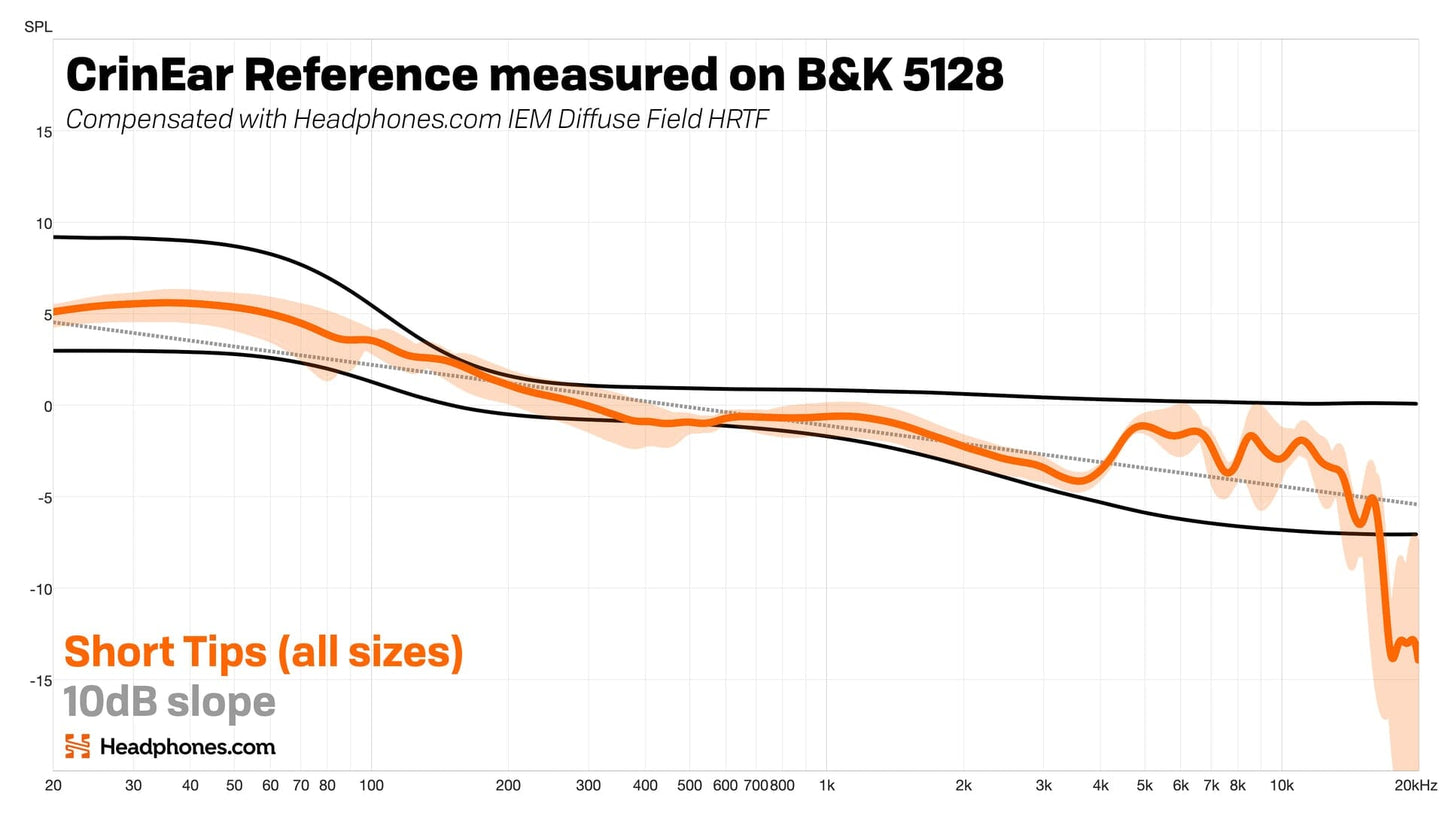
The B&K 5128 measurements back up that goal. The CrinEar Reference tracks a very even overall slope from bass to treble, with both the short tips and standard tips landing in a range that should read as neutral to neutral-warm for most listeners. In practical terms, that points to an IEM with balanced bass, mids, and treble rather than one that leans obviously bright, thin, or bass-heavy.


This shows the CrinEar Reference measurements for each set of tips done on the B&K 5128. These measurements show seatings for each tip size, which change the insertion depth of the IEM and change the sound. The shaded area shows the outer range of results while the bolded center line shows the more common result, but for any individual, depending on insertion depth, the sound could be anywhere within the shaded area. The bounded field marked by solid lines on top and bottom shows the range of preferences we know to exist from the Harman research, while the dotted center line shows a tilt of 10dB from bass to treble, which aligns with typical listener preferences in both headphones and speakers.
Just as importantly, these measurements show why tip choice matters. The shaded area represents the outer range of results across tip sizes and seatings, while the bold center line represents the more common result. Because insertion depth changes the sound, an individual listener may hear something anywhere within that shaded range. That is not a flaw. It is a reminder that the Reference is sensitive to fit, and that dialing in the right tip can meaningfully affect how neutral, warm, or direct it sounds in your ears.
Objective Neutrality, Refined for Real Listening
CrinEar’s stated target is a population-averaged diffuse-field response with a gentle downward tilt, then a subtle low-frequency lift to restore the sense of physicality people expect from a good speaker system or studio monitor in a real room. That is an important choice. Plenty of products chase flatness on paper. Far fewer manage to sound natural once they are actually in your ears.
Here, the bass lift is there to preserve realism, not to turn the Reference into a bass-boosted set. The end result should be familiar to anyone who values accurate monitors: controlled, even-handed, and honest, with enough foundation down low to keep the sound grounded.
Tuned for the Studio, Built for Daily Use
The Reference is designed as a genuine monitoring tool. It is meant for critical listening, mix checks, and anyone who wants reliable tonal balance without constantly having to second-guess what the IEM is adding or taking away. Midrange clarity is central to that job. If vocals, instruments, and the body of the mix are not presented with the right balance and weight, nothing works as a true reference monitor.
That is also why the bass system matters so much here. A flat target is only useful if the low end stays disciplined. The Reference is built to keep bass extension and physicality without letting it blur into the rest of the mix, which makes it more useful for long-term listening and more credible as a tool.
HODWS Architecture and 3BA Driver System
Bass is handled by a custom Horizontally-Opposed Dual Woofer System, or HODWS, using two 10 mm dynamic drivers. By splitting the mechanical load across both woofers, the system is designed to reduce stress on each diaphragm, improve bass linearity, improve efficiency, and deliver tighter, more controlled low-end response. That is a smart way to approach bass on a neutrality-first IEM, because “flat bass” still needs to sound like real bass.
For the mids and highs, the Reference uses a three balanced armature array made up of twin Sonion midrange drivers and a Knowles supertweeter. That gives the Reference a clear division of labor across the frequency range, with the dual dynamic system handling foundation and weight while the BA array focuses on articulation, presence, and upper-end detail.
Tip Choice and Fit Matter
The included tip selection is not filler. It is part of how the Reference should be used. Between the standard bore, shorter bore, widebore, and foam options, listeners have multiple ways to tune fit, insertion depth, seal, and final tonal balance. The measurements show why that matters: seating changes the response, especially as you move through the upper mids and treble.
For most people, the Reference should land somewhere between neutral and neutral-warm once properly fitted. The best approach is to treat the included tips as part of the setup process, not just accessories in the box. The right tip will not only improve comfort and seal, it will help the Reference sound closer to the way it was intended.
Built to Last, Easy to Live With
The Reference uses a full aluminum shell precision-machined with a 5-axis CNC process. The pseudo-custom shape is designed to sit securely for longer sessions while helping control enclosure resonance. It feels purposeful, which suits a product aimed at both serious enthusiasts and professional users.
CrinEar also includes a premium silver-plated copper modular cable with interchangeable 3.5 mm single-ended and 4.4 mm balanced connectors. That makes the Reference easy to move between portable dongles, DAPs, desktop gear, and more serious source chains without needing to swap cables or give up connection flexibility.
Key Features
- Neutrality-first in-ear monitor designed for tonal accuracy and mix translation
- Follow-up to the CrinEar Daybreak with a more specialized reference tuning
- B&K 5128 measurements suggest a neutral to neutral-warm presentation for most listeners, depending on tip choice and insertion depth
- Perceptually flat tuning with a subtle low-frequency lift for realism and physicality
- Dual 10 mm dynamic driver HODWS bass system for tighter, more linear low-end response
- Three balanced armature drivers for midrange and treble reproduction
- Twin Sonion midrange drivers and one Knowles supertweeter
- 5-axis CNC-machined full aluminum shells
- Pseudo-custom shell geometry for comfort and stability
- Premium silver-plated copper modular cable included
- Interchangeable 3.5 mm single-ended and 4.4 mm balanced connectors
- Multiple tip styles included to optimize fit, insertion depth, and tonal balance
- Leatherette zip case included
Technical Specs
| Product Type | Wired in-ear headphones / in-ear monitor |
| Price | $349.99 |
| Driver Configuration | 2 x 10 mm dynamic drivers + 3 balanced armature drivers |
| Bass System | HODWS, Horizontally-Opposed Dual Woofer System |
| Balanced Armature Array | 2 x Sonion midrange drivers + 1 x Knowles supertweeter |
| Impedance | 16Ω @ 1 kHz |
| Sensitivity | 104 dB/mW @ 1 kHz |
| Frequency Response Range | 2 Hz to 44,000 Hz |
| Housing | 5-axis CNC-machined full aluminum shell |
| Nozzle Width | 6.0 mm lip |
| Cable Material | Silver-plated copper |
| Connectors Included | 3.5 mm single-ended and 4.4 mm balanced interchangeable terminations |
What’s in the Box
- CrinEar Reference in-ear headphones
- Silver-plated copper modular cable
- 3.5 mm single-ended interchangeable connector
- 4.4 mm balanced interchangeable connector
- S/M/L standard bore silicone eartips
- S/M/L shorter bore silicone eartips
- XS/S/M/L widebore silicone eartips
- M foam eartips
- Leatherette zip case
Reviews